Accreditation and Certification in achieving Quality Assured TVET

Date: February 26, 2024 - March 1, 2024 /
Program Type: In-Country Program /

Main Contents

Theme Papers & Presentations on the following:

  • Special Lecture: Benchmarking Quality Assurance of TVET Institutions
  • Theme Paper 1: Overview of TVET Quality Assurance System by NAVTTC
  • Presentation 1: A Decade of Institutional Accreditation Impac, on Pakistan TVET system with Benefits and Challenges
  • Presentation 2: Role of NAC Accreditation for uplifting TVET Regime in Pakistan
  • Theme Paper 2: Institutional Accreditation as Quality Assurance for TVET Institution operations & work Procedures
  • Theme Paper 3: Program Accreditation as Quality Assurance for Standard Programs
  • Theme Paper 4: Role of the Skills National Assessment and Certification System as a Quality Assurance System
  • Theme Paper 5: APACC for Accreditation and Certification of TVET Institutions in Asia Pacific Region

APACC Orientation Sessions

  • Class Session 1: Governance and Management (Criteria 1)
  • Class Session 2: Teaching and Learning (Criteria 2)
  • Class Session 3: Human Resources (Criteria 3) and Research and Development (Criteria 4)
  • Class Session 4: Image & Sustainability (Criteria 5) and Other Resources (Criteria 6)
  • Class Session 5: Support to Students ( Criteria 7)

Exercises and workshops on the following:

  1. Conduct a SWOT Analysis on the Institutional Quality Assurance
  2. Identification of Major Issues & Challenges in Maintaining a Quality Assurance System
  3. Workshop on Criteria 1 and 2
  4. Workshop on Criteria 3 and 4
  5. Workshop on Criteria 5 and 6
  6. Workshop on Criteria 7

Objectives

The participants are expected to:

  1. Understand the concept of Quality Assurance System
  2. Appreciate the need and importance of accreditation and certification of TVET programs and institutions to respond to the national, regional, and global labor market
  3. Understand the nature and significance of various criteria and parameters used for accreditation as a tool for improving the quality of TVET Institutions
  4. Comprehend the steps involved in the process of accreditation
  5. Prepare the documents needed for submission to accrediting agencies
  6. Create a discussion opportunity and experience sharing for the institute representatives aimed to exchange relevant information on how to enhance quality assurance offerings in TVET for their institute

Greening TVET for Sustainable Development

Date: January 29, 2024 - February 2, 2024 /
Program Type: In-Country Program /

Main Contents

To achieve the objectives set forth, the following strategies will be employed in a consultative manner:

Theme papers and presentations on the following:

  • Special Lecture: Greening TVET as an SDG 2030 Strategy: Current Concepts, Practices, and Future Agenda
  • Theme Paper 1: Importance of Green Skills in Sustainable Development
  • Theme Paper 2: Strategies and Practical Approaches for Greening Campuses
  • Theme Paper 3: Integrating Green Skills in the TVET Curriculum
  • Theme Paper 4: TVET Digitization for Global Competitiveness
  • Theme Paper 5: The Future of TVET with IR 4.0 to TVET 4.0
  • Theme Paper 6: Best Practices of Greening TVET in the Global Context

Workshops & Activities

  • Workshop 1: Conduct a SWOT Analysis of the Green TVET Institute Environment
  • Workshop 2: Identification of Major Issues and Challenges in Greening Campuses for Sustainable Development through PESTEL Analysis
  • Workshop 3: Prepare an action plan for the Integration of Green Skills in the TVET institute.

National Seminar on “Greening Skills for Sustainable Development”

  • Session 1: The Role of Education in Fostering Green Mindsets and Skills
  • Session 2: Circular Economy: Redefining Resource Efficiency
  • Session 3: Green Tech Startups: Catalyzing Innovation for a Sustainable Future
  • Session 4: Renewable Energy Transition: Challenges and Opportunities
  • Session 5: Smart Cities: Integrating Sustainability into Urban Planning
  • Session 5: Open Forum

Objectives

The overall objective of the Greening TVET for Sustainable Development training program is to maintain a green society through TVET professionals by empowering students with green knowledge, skills, and attitudes. The specific objectives of the program are to effectively and efficiently analyze emerging trends and challenges in greening TVET for sustainable development for the benefit of future generations.

The participants are expected to:

Leadership and Management of TVET Institute

Date: December 11-15, 2023 /
Program Type: In-Country Program /

Main Contents

To achieve the objectives set forth, the following strategies will be employed in a consultative manner:

Special Lecture and Presentations on the following:

  • Special Lecture: Development, Issues, and Challenges for Global Leadership and Management in TVET
  • Theme Paper 1: 21st Century Skills and IR 4.0 for Global Competitiveness and Innovation in the TVET
  • Theme Paper 2: Management Concepts and Paradigms of Improving Institutional Management in the TVET Systems Strategic Plan
  • Theme Paper 3: Change Management: Enhancing Leadership and Achieving Organizational Excellence in TVET
  • Theme Paper 4: Enhancing TVET Leadership and Management through Accreditation and ICT
  • Theme Paper 5: Excellence of Leadership for Change Management Through the PDCA Cycle in TVET

Exercises and workshops on the following:

  • Workshop 1: TVET Institute Management Issues and Their Technical Analysis in Sri Lanka
  • Workshop 2: Institutional Visit: TVET Institutional Best Practices with Brand Concept Management
  • Workshop 3: Identify and analyze technological gaps through critical analysis

Conference on Emerging Technologies and Skills for Resilient Industries

Presentations on the following:

  • Resilient industries for a sustainable future
  • Innovative approaches for resilient technological solutions
  • ICT towards Resilience: Harnessing Information and Communication Technologies for Sustainable Development
  • Education and language studies: transformative and innovative pedagogies and language learning for resilient learning
  • TVET Skills and Competencies for Resilient Workforce Development

Objectives

The participants are expected to:

  • Recognize the vital role of leadership and management at the TVET Institute in the socioeconomic development of the country by developing a visionary leadership approach that sets clear goals and a strategic direction for the TVET Institute;
  • Learn about effective leadership and management to make an impact in society regarding technical and vocational education and training;
  • Understand leadership and management as effective tools for TVET development;
  • Develop a project in group for creating an effective leadership and management strategy for TVET;
  • Promote inclusivity and diversity within the TVET institute to accommodate learners from various backgrounds, including individuals with disabilities;
  • Embrace digital transformation and integrate technology into the teaching and learning process to enhance accessibility and engagement;
  • Establish a robust monitoring and evaluation system to assess institutional performance and identify areas for improvement;
  • Implement data-driven decision-making processes to enhance the effectiveness and efficiency of the TVET institute, and
  • Cultivate a culture of continuous improvement to adapt to changing industry needs and evolving educational trends.

Driving Digital Technology in TVET

Date: December 15, 2023 /
Program Type: Webinar /

11:30am Afghanistan | 12:00pm Maldives, Pakistan | 12:30am India, Sri Lanka | 12:45am Nepal | 1:00pm Bangladesh, Bhutan | 1:30pm Myanmar | 2:00pm Thailand | 3:00pm China, Malaysia, Mongolia, Philippines, Singapore | 5:00pm Papua New Guinea | 7:00pm Fiji


Background

The theme Driving Digital Technology in TVET refers to the necessity of incorporating cutting- edge digital technologies into the world of Technical and Vocational Education and Training (TVET). This movement is motivated by the need to have a workforce that is proficient in and literate in digital technology. This theme's summary centres on the strategic integration of digital technologies including virtual reality, IR 4.0 curriculum: Digital technology, e-learning platforms, data analytics, and cybersecurity education, within the TVET curriculum. Within the context of digital technology, a range of curriculum-related challenges brings to fore varied relevant issues in TVET. These challenges arise due to the unique nature of the Digital Technology sector, characterized by its rapid evolution and dynamic nature. One significant challenge involves is keeping abreast with the latest industry trends and emerging technologies. The field of Digital Technology is constantly evolving, with new programming languages, frameworks, tools, and methodologies frequently emerging. Curriculum developers must continuously update their programs to reflect these changes, ensuring that students are learning relevant skills that are applicable in the current job market. Overcoming these challenges requires proactive and continuous efforts, collaboration with industry stakeholders, staying current with industry trends, fostering practical skills, and maintaining a balance between fundamental knowledge and specialized skills. By addressing these challenges strategically, these institutions can ensure that their graduates are well-prepared to excel in the ever-evolving digital technology landscape.

This change improves educational opportunities, encourages students to learn new skills, and fosters adaptability which would prepare them for the ever-changing demands of today's technologically based industries. The main objective is to close the knowledge and competency gap between conventional skills and contemporary technological breakthroughs, equipping TVET graduates with the knowledge and abilities necessary to thrive in a digital era. As we delve into this issue, we consider best practices, obstacles, joint endeavours, and the shared desire of developing a workforce that is secure online and prepared to influence the direction of industries around the world.


Objectives

Sub-theme 1

  • What are some curriculum-related challenges faced by Malaysia and India’s TVET education institutions specializing in digital technology?
  • How can TVET develop a digital technology curriculum that is aligned with industry standards?

Sub-theme 2

  • How can we incorporate cybersecurity education into TVET programs to ensure that graduates are well-prepared to address the growing threats in the digital world?
  • How can we empower individuals with the skills and knowledge needed to not only protect digital assets but also play an active role in shaping a secure digital future?


Navigating the Future of TVET: Addressing Challenges and Fostering Positive Change

Date: December 4-6, 2023 /
Program Type: Regional Program /

Main Contents

To achieve the objectives set forth, the following strategies will be employed in a consultative manner:

International Conference on “Revolutionizing the Future Workforce: Transformative Pathways of TVET towards 2030”

Presentations on:

  1. Quality Assurance in TVET: Addressing IR 4.0 Challenges
  2. Toyota Production System
  3. Benchmarking Quality Assurance in TVET

Workshops and visit on:

  1. Country Paper Presentation on Best Practices in Enhancing Quality and Relevance of TVET System
  2. Exposure Visits

Objectives

The participants are expected to:

  • Develop leadership capabilities among TVET educators to drive innovative reforms and strategic planning and total quality management within institutions and organization.
  • Enhance participants' understanding of global workforce trends, equipping them to prepare graduates for success in both domestic and international job markets.
  • Cultivate TVET leaders who champion green skills and eco-friendly practices, enabling graduates to contribute to sustainable development initiatives.
  • Strengthen TVET institutions through capacity-building, fostering collaborations, and providing exposure to cutting-edge infrastructure for higher-quality education.
  • Drive the evolution of a sustainable and dynamic TVET ecosystem through effective leadership, innovation, and continuous improvement.

Revolutionizing the Future Workforce: Transformative Pathways of TVET towards 2030

Date: December 4, 2023 /
Program Type: International Conference

Objectives

The participants are expected to:

  1. Understand the emerging trends and patterns in TVET focusing on technological advancements in developed countries.
  2. Gain knowledge about how partnerships between TVET institutions, industries, policymakers, and stakeholders can strengthen the bridge between education and the job market.
  3. Explore innovative approaches to how member countries are updating and adapting TVET curricula to meet the evolving skill demands of the job market.
  4. Address barriers to accessing TVET opportunities and promote inclusivity, regardless of socioeconomic background, gender, or geographical location.
  5. Enhance their knowledge of quality assurance mechanisms in TVET through effective accreditation, regular evaluations, and industry feedback.
  6. Promote the concept of lifelong learning within TVET institutions, encouraging individuals to continuously update their skills throughout their careers.
  7. Explore the integration of sustainability and green skills into TVET curricula, addressing environmental challenges and promoting sustainable practices.
  8. Provide them an opportunity to discuss strategies to bridge the digital divide and ensure equitable access to digital infrastructure, internet connectivity, and digital skills training in TVET.
  9. Provide a platform for sharing best practices, success stories, and innovative solutions in TVET

Innovative Teaching Methods

Date: October 30 - November 3, 2023 /
Program Type: In-Country Program /

Main Contents

To achieve the objectives set forth, the following strategies will be employed in a consultative manner:

Theme Papers and Presentations on the following:

  • Theme Paper 1: Integrated 21st Century Skills in TVET
  • Theme Paper 2: Digitalization in TVET
  • Theme Paper 3: TVET Digital Framework and New Skills
  • Theme Paper 4: Tools and Applications for Digital Learning
  • Theme Paper 5: Digital Learning Pedagogy and Platforms
  • Theme Paper 6: AR, VR, and MR
  • Theme Paper 7: Excellence of Leadership for Change Management through the PDCA Cycle in TVET

Workshops and Activities

  • Workshop 1: Understanding and Analyzing TVET Institute Readiness for Implementing Digital Learning
  • Workshop 2: Creating Digital learning Lesson Plans and Assessments, and Preparing eContent Script for Lessons
  • Workshop 3: Create a Sample Online Course/Courseware Using LMS

National Seminar on “Virtual TVET Globalization in the Digital Era”

  • Session 1: Virtual TVET and the 21st-Century Classroom
  • Session 2: Global Digital Trends in Teacher Education and Training
  • Session 3: TVET Digitalization and Industrial Linkages
  • Session 4: Smart Industry Readiness Index
  • Session 5: Q & A

Objectives

The objectives of the ICP on “Innovative Teaching Methods” are as follows:

  • Deliberate the emerging trends and challenges of lR 4.0 to transform TVET education;
  • Examine the innovative ‘Blended Education Learning and Augmented Training Approach (BELATA)’ for adoption in the TVET system”;
  • Create a sample online course or courseware using an e-learning management system (MOODLE) and implement the blended learning environment.
  • Build the capacity of the TVET Institute to incorporate digital learning to facilitate a flexible and effective learning platform.

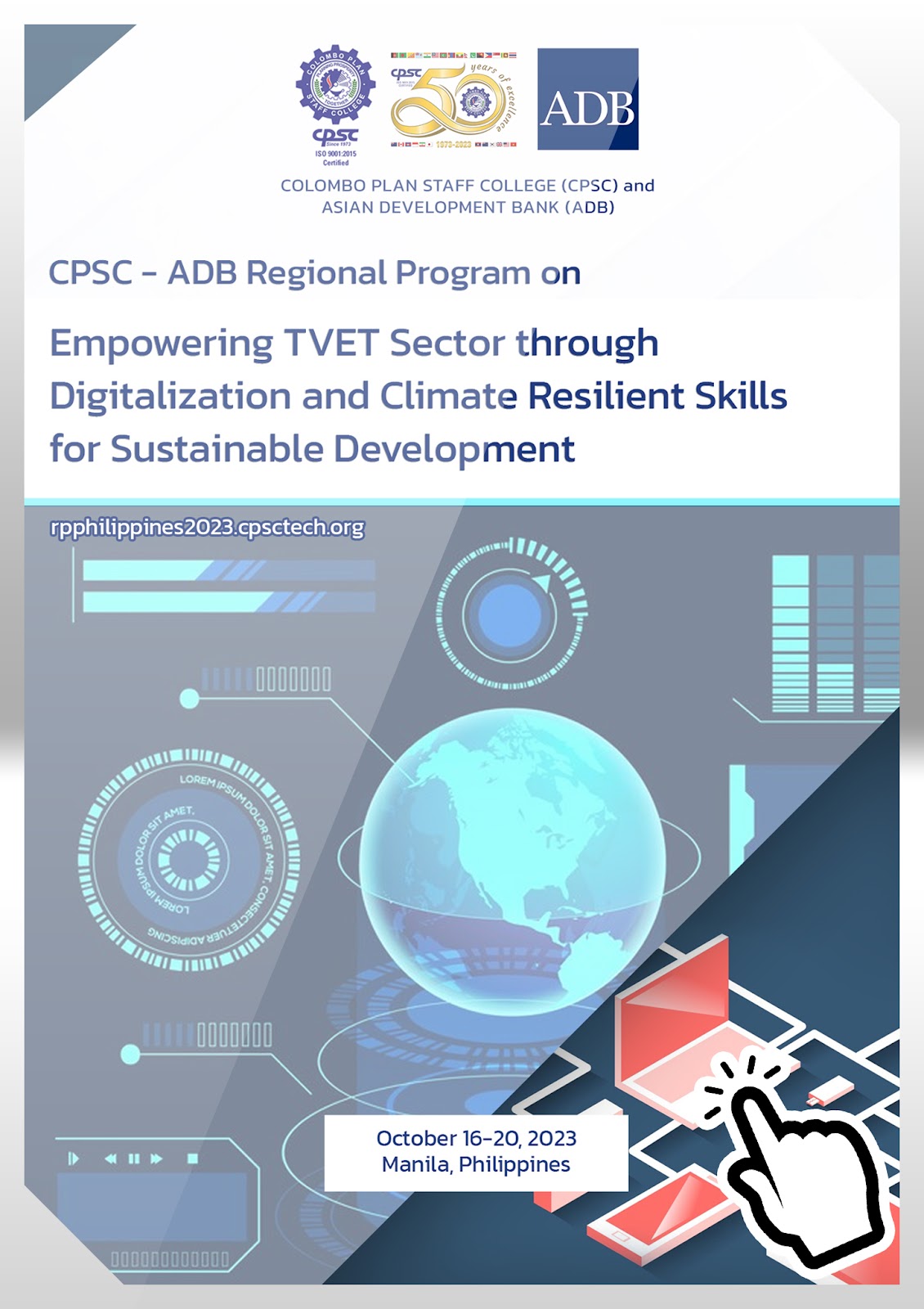
Empowering TVET Sector through Digitalization and Climate Resilient Skills for Sustainable Development

Date: October 16-20, 2023 /
Program Type: Regional Program /

Main Contents


Presentations on:

  • Special Lecture 1: TVET Institutes Management for Global Competitiveness

10th ADB International Skills Forum

  • A new Era of Digitalized and Climate Resilient Human and Social Development

Exercises and workshops on the following:

  • SWOT Analysis for 21st Century
  • Country based Challenges Presentations based on Conference Topics

Objectives

At the end of the program, participants should be able to:

  • Understand the integration of digital literacy into the latest TVET trends to empower diverse learners with essential digital skills for active participation in the digital economy.
  • Emphasize climate resilient skills and green technologies in TVET programs to prepare learners for environmental sustainability and climate challenges.
  • Examine the integration of sustainability principles across all TVET disciplines to foster environmentally conscious practices.
  • Explore the collaboration with industries to design TVET programs that equip learners with relevant digital skills for enhanced employability.
  • Comprehend the new era state-of-the-art Digital Skills Academies which are providing comprehensive digital training and competence development.
  • Observe specialized centers for hands-on training in sustainable practices, renewable energy, and climate resilience.
  • Promote an entrepreneurial culture in the TVET sector by offering courses and workshops on innovation and business development.
  • Explore a community-centric approach to tailor TVET programs to address region-specific challenges and promote positive impact.
  • Understand the benefits of providing equal opportunities for all learners, promoting gender equity and social inclusion within the TVET sector.
  • Examine Data-driven mechanisms to explore the program impact, enabling continuous adaptation and relevance in Country perspective.

Revolutionalize TVET: Innovation in Transformational Pedagogy, Competency Building and International Collaboration

Date: October 2-5, 2023 /
Program Type: Regional Program /

Main Contents


Presentations on the following:

  • Theme Paper 1: Introduction to PEEP
  • Theme Paper 2: TVET-GOGY & Future Teaching and Learning
  • Theme Paper 3: Transversal Skill for TVET
  • Theme Paper 4: Building Transversal Competency with TRIZ
  • Theme Paper 5: International Collaboration and Partnership

Exercises and workshops on the following:

  • Workshop 1: TVET-GOGY & Future Teaching and Learning
  • Workshop 2: Transversal Skill for TVET
  • Workshop 3: Building Transversal Competency with TRIZ

International Seminar: TVET Globalization


Instructional Strategies

To achieve the objectives set forth, the following strategies will be employed in a consultative nature: An integrated teaching and learning methodology which include interactive activities, discussions, simulation exercise, and group work on assignment and case study. This course will be fully conducted in English.


Objectives

  • Create a diversity of TVET teaching methodologies to enhance TVET educators’ professional development.
  • Establish transversal competency skills of TVET Educators to be used as a reference within and outside institutions.
  • Engage TVET Educators between countries to strengthen networking for the internationalization of TVET.