Showing posts with label Philippines. Show all posts

Empowering DepEd’s Tech-Pro Track: Gateway to Workforce Development and TVET - General Education Integration in the Philippines

Date: July 28-31, 2026 /
Program Type: Customized Program /

PROGRAM OBJECTIVES

At the end of the program, the participants are expected to: 

  • Analyze global models for TVET integration
  • Strengthen policy alignment and governance
  • Design competency-based technical education systems
  • Enhance teacher professional development
  • Strengthen industry linkages and workforce alignment
  • Integrate digital transformation and future skills
  • Promote green, inclusive, and sustainable TVET
  • Strengthen quality assurance and institutional excellence  
  • Develop evidence-based monitoring and evaluation systems
  • Formulate institutional and national action plans

EXPECTED OUTPUTS

In the four-day training program, participants will engage in collaborative discussions, guided workshops, simulation exercises, institutional self-assessments, and strategic planning activities. Designed to translate international best practices into actionable strategies for the Department of Education (DepEd) Technical Professional (Tech-Pro) Track.

By the end of the program, participants are expected to produce the following outputs:

  • Global TVET benchmarking matrix
  • Policy and governance alignment framework
  • Institutional SWOT analysis and gap assessment
  • Competency-based curriculum and learning pathway framework
  • Teacher competency development and industry immersion roadmap
  • Industry partnership and workforce alignment strategy 
  • AI-enabled digital transformation roadmap
  • Green TVET and inclusive education integration plan
  • Quality Assurance and Institutional benchmarking framework
  • Monitoring, evaluation, and KPI Framework
  • DepEd Tech-Pro strategic action plan
  • Community of practice and regional knowledge-sharing network

Organizational Planning: Strategic Planning in TVET

Date: June 1-4, 2026 /
Program Type: In-Country Program /

OBJECTIVES

The training program is designed to: 

  • Promote a shift in the mindset of the TESDA institutions from routine, compliance-based planning to strategic, values-driven decision-making aligned with the TESDA’s Best 8-Point Agenda.
  • Enhance the strategic thinking and planning capabilities of officials and personnel within TESDA, particularly in translating institutional priorities into clear plans, targets, responsibilities, and reform actions by means of APACC QA tools.
  • Strengthen behavior-related competencies essential for strategic leadership, including collaboration, innovation, accountability, change readiness, and reform ownership.
  • Foster a culture of continuous improvement and foresight by equipping participants with practical tools for environmental scanning, scenario planning, risk awareness, monitoring, and performance review.
  • Enable participants to prepare institutional strategic plans and personal commitment statements that reflect shared accountability, mindset transformation, and measurable implementation pathways.

Senior Executives' Conference on Forging a Future Ready TVET Strategy: CPSC Strategic Plan 2023-2028 - Midterm Review

Date: December 4, 2025 /
Program Type: Conference /

Program Contents

  1. Keynote by the Director General, CPSC / President APACC
  2. Presentations by CPSC Faculty on:
    1. CPSC / APACC introduction
    2. Significance and overview of Strategic Plan 2023–28
    3. Accomplishments of CPSC & APACC 2023–25
    4. Identification of issues, challenges and bottlenecks
    5. Experts meeting recommendations
  3. Interactive Group Deliberations and feedback on institutional alignment and partnerships by the participants
  4. Strategic Endorsement Session for realignment of the Strategic Plan 2025–2028.

Strategic Planning in TVET cum Expert Meeting on Midterm Review and Evaluation of CPSC Strategic Plan 2023-2028

Date: October 22–23, 2025 (Online)
October 27-31, 2025 (On-site) /
Program Type: Regional Program /

Program Contents

Presentations/Theme papers on the following:

  • Theme Paper 1: Strategic Planning & Management in TVET
  • Theme Paper 2: Emerging Trends, Technologies, and Transformative Practices in TVET
  • Theme Paper 3: Enhancing TVET Quality through the New APACC Accreditation Manual
  • Theme Paper 4: Harnessing TVET for Sustainable Development Goals (SDGs)
  • Theme Paper 5: Navigating the Future: Strategic Thinking and Scenario Building in TVET

Presentations/Theme papers on the following:

Tasks/Activities

  • Mid-term Strategic Plan Review Workshops
  • Country Presentations and Policy Dialogues
  • Plenary Sessions and Panel Discussions at CSU
  • SWOT Analysis and Strategic Roadmap
  • Group Discussions and Action Planning
  • Networking and Institutional Collaboration

International Conference on “Global Landscape: Aligning TVET and Industry for Sustainable Development”

Enhancing TVET Institutions and Industry Linkages for Quality TVET

Date: June 23-26, 2025 /
Program Type: In-Country Program /

Main Contents

Special Lecture and Theme Papers:

  • Special Lecture: TVET-Industry Synergies for Enhanced Employability
  • Theme Paper 1: Building Sustainable Industry-Institute Partnerships in TVET
  • Theme Paper 2: Country Presentations (TESDA/Participants) – Current Concepts and Challenges in TVET–Industry Linkages
  • Theme Paper 3: Aligning TVET with Industry 4.0, 5.0: Skills for Future Workforce
  • Theme Paper 4: Innovative Models of Dual Training Systems and Work-Based Learning
  • Theme Paper 5: Role of Policy and Government in Promoting Effective Linkages
  • Theme Paper 6: Integrating Entrepreneurship and Innovation
  • Theme Paper 7: Monitoring Outcomes – Tracer Studies and Employability Metrics in TVET
  • Theme Paper 8: Incorporating Sustainability, Social Equality and Green Practices into TVET for Achieving SDGs

Group Work Activities (GWA)

  • Task Exercise 1: SWOT and Gap Analysis of TVET–Industry Linkages in the Philippines

Purpose: Analyzing current linkages and identify strengths, weaknesses, opportunities and threats

  • Task Exercise 2: Integration of Emerging Technologies into existing institute-industry partnership

Purpose: Simulate collaborative curriculum design with industry to ensure skills relevance.

  • Task Exercise 3: Institutional Action Planning for Sustainable Industry Engagement

Purpose: Develop strategic plans for long-term industry collaboration in participants' institutions.

  • Workshop 1: PDCA -Monitoring Outcomes-Tracer Studies and Employability Metrics in TVET.
  • Workshop 2: Co-Creating TVET Curricula with Industry – A Simulation Exercise

Quality Assurance of TVET Institutions through Accreditation

Date: May 19-23, 2025 /
Program Type: Regional Program /

Main Contents

To achieve the objectives set forth, the following strategies will be employed in a consultative nature:

Presentations on the following:

Special Lecture: Quality Assurance in TVET through APACC Accreditation.

Theme Papers

  • Theme Paper 1: Global Concept of Quality Assurance and Quality Standards in TVET
  • Theme Paper 2: Next-Gen Accreditation for 21st century TVET practices: Harnessing AI, data-driven decisions & Industrial Partnerships
  • Theme Paper 3: Incorporating Sustainability, Social Equality and Green Practices into Accreditation Standards (Developing Sustainable Accreditation Models)

Task Exercises, Presentation, and Workshop on the following:

  • Task Exercise 1: SWOT Analysis of Existing Quality Assurance Systems of CPSC member countries
  • Task Exercise 2: Drafting Logical Frameworks for TVET QA
  • Workshop: Discussion on APACC Strategic Plan 2025-2028 (Culminating in its finalization)

Program Objectives

At the end of the course, participants should be able to:

  • Appreciate the need and importance of quality assurance and regional/global accreditation in TVET;
  • Identify best practices in TVET Quality Assurance Systems and accreditation practices in CPSC member countries;
  • Gain insights on APACC accreditation as a continuous improvement approach to organizational excellence in TVET; and
  • Develop an action plan to prepare for APACC accreditation at Institutional/national context.
  • Provide inputs leading to finalization of APACC Strategic Plan 2025-2028.

Quality Assurance in TVET Programs and Services Delivery of Institutions through Accreditation

Date: March 11-12, 2025 /
Program Type: Open Registration Program /

Program Contents

Expected Outcomes and Outputs

The following instructional methodologies will be utilized to effectively train the participants:

  • General Information about APACC and Procedures
  • Orientation on the APACC Criteria
    • Criterion I: Governance and Management
    • Criterion II: Teaching and Learning
    • Criterion III: Human Resources
    • Criterion IV: Research and Development
    • Criterion V: Image and Sustainability
    • Criterion VI: Other Resources
    • Criterion VII: Support to Students
  • Preparation for Accreditation
  • Developing an Institutional System Development Plan

Objectives

At the end of the program, the participants are expected to:

  • Appreciate the need and importance of standards, quality, and accreditation relative to the national, regional, and global labor market;
  • Understand accreditation as a tool for improving the quality of TVET Institutions;
  • Develop institutional internal experts who can be proficient using the APACC accreditation system and manual for the future experience cascading; and
  • Assist participants to draw a system development plan for APACC accreditation.

Exploring Research in TVET: Design and Development

Date: June 20-22, 2024 /
Program Type: Customized Program /

Objectives

The objectives of the training program are to:

  • enhance the quality, relevance, and effectiveness of vocational education and training programs through research
  • develop basic skills in conducting research in TVET
  • prepare a capsule research proposal

Program Contents

In order to achieve the above objectives, the following steps in generating a research project will be covered:

  • Step 1: Choose your topic
  • Step 2: Identify a problem
  • Step 3: Formulate research questions
  • Step 4: Create a research design
  • Step 5: Write a research proposal

Enhancing Quality of TVET Graduates through User-Centered Problem-Solving Method (Design Thinking)

Date: June 17-19, 2024 /
Program Type: Customized Program /

Objectives

At the end of the program, the participants will be able to:

  1. Be exposed to the 5-step process of Design Thinking;
  2. Experience carrying out the 5-steps of Design Thinking;
  3. Gain knowledge, skills and competencies to develop creative and innovative student projects;
  4. Be more adaptive in solving real world issues; and
  5. Be equipped with skills to communicate and cooperate effectively.

Expected Outcomes and Outputs

The program focuses on the 5 steps of a Design Thinking process. By participating in this program, participants will be exposed to a creative problem-solving strategy to address issues/ challenges that are prevalent in their institutions, communities or industries. Participants will acquire tools, resources and skills to work in teams to understand target user needs, generate innovative ideas, and create plausible solutions. The outcome of this program can be adapted to different contexts and situations.

Expected Outputs:

  1. Participants identify a challenge/issue by interviewing respondents/ target users
  2. Participants use 5 step- Design Thinking process to solve the challenge /issue
  3. Participants produce a prototype or solution by working in teams
  4. Participants present their prototype in a pitching session

Leadership for the 21st Century

Date: April 22-26, 2024 /
Program Type: In-Country Program /

Main Contents

To achieve the objectives set forth, the following strategies will be employed in a consultative manner:

Special Lecture and Presentations on the following:

  • Special Lecture: Characteristics and Traits of effective leadership in TVET management
  • Special Lecture-2: Emerging Challenges for TVET Leadership in the 21st Century
  • Theme Paper 1: Human Resource Management as a skill in 21st Century
  • Theme Paper 2: Research & Innovation Management in TVET Institution
  • Theme Paper 3: Project Management skills & Competencies for TVET leaders to attract Donors funding
  • Theme Paper 4: Effective Communication Strategies for 21st Century Leaders
  • Theme Paper 5: Integration of Competency-based Curricula & Training in 21st Century
  • Theme Paper 6: Leadership for Quality Assured TVET Institutions
  • Theme Paper 7: Change Management: Enhancing Leadership and Achieving Organizational Excellence in TVET

Exercises and workshops on the following:

  • Workshop 1: TVET Institute Management Issues & its Technical AnalysisIn the Philippines
  • Workshop 2: Creating Competency-Based Management by Integrating Strategic Planning Skills
  • Workshop 3: TVET Institute Image Building through Brand Concept Management

Objectives

The participants are expected to:

  • Understand 21st Century leadership as an effective tool for TVET development.
  • Identify the characteristics and traits of an effective leader
  • Understand the emerging challenges faced by leaders in the 21st century
  • Discuss the various leadership skills and types
  • Apply and integrate the 21st century knowledge and skills gained to enhance their respective leadership roles and responsibilities
  • Cultivate a culture of continuous improvement to adapt to changing industry needs and evolving educational trends.

Navigating the Future of TVET: Addressing Challenges and Fostering Positive Change

Date: December 4-6, 2023 /
Program Type: Regional Program /

Main Contents

To achieve the objectives set forth, the following strategies will be employed in a consultative manner:

International Conference on “Revolutionizing the Future Workforce: Transformative Pathways of TVET towards 2030”

Presentations on:

  1. Quality Assurance in TVET: Addressing IR 4.0 Challenges
  2. Toyota Production System
  3. Benchmarking Quality Assurance in TVET

Workshops and visit on:

  1. Country Paper Presentation on Best Practices in Enhancing Quality and Relevance of TVET System
  2. Exposure Visits

Objectives

The participants are expected to:

  • Develop leadership capabilities among TVET educators to drive innovative reforms and strategic planning and total quality management within institutions and organization.
  • Enhance participants' understanding of global workforce trends, equipping them to prepare graduates for success in both domestic and international job markets.
  • Cultivate TVET leaders who champion green skills and eco-friendly practices, enabling graduates to contribute to sustainable development initiatives.
  • Strengthen TVET institutions through capacity-building, fostering collaborations, and providing exposure to cutting-edge infrastructure for higher-quality education.
  • Drive the evolution of a sustainable and dynamic TVET ecosystem through effective leadership, innovation, and continuous improvement.

Revolutionizing the Future Workforce: Transformative Pathways of TVET towards 2030

Date: December 4, 2023 /
Program Type: International Conference

Objectives

The participants are expected to:

  1. Understand the emerging trends and patterns in TVET focusing on technological advancements in developed countries.
  2. Gain knowledge about how partnerships between TVET institutions, industries, policymakers, and stakeholders can strengthen the bridge between education and the job market.
  3. Explore innovative approaches to how member countries are updating and adapting TVET curricula to meet the evolving skill demands of the job market.
  4. Address barriers to accessing TVET opportunities and promote inclusivity, regardless of socioeconomic background, gender, or geographical location.
  5. Enhance their knowledge of quality assurance mechanisms in TVET through effective accreditation, regular evaluations, and industry feedback.
  6. Promote the concept of lifelong learning within TVET institutions, encouraging individuals to continuously update their skills throughout their careers.
  7. Explore the integration of sustainability and green skills into TVET curricula, addressing environmental challenges and promoting sustainable practices.
  8. Provide them an opportunity to discuss strategies to bridge the digital divide and ensure equitable access to digital infrastructure, internet connectivity, and digital skills training in TVET.
  9. Provide a platform for sharing best practices, success stories, and innovative solutions in TVET

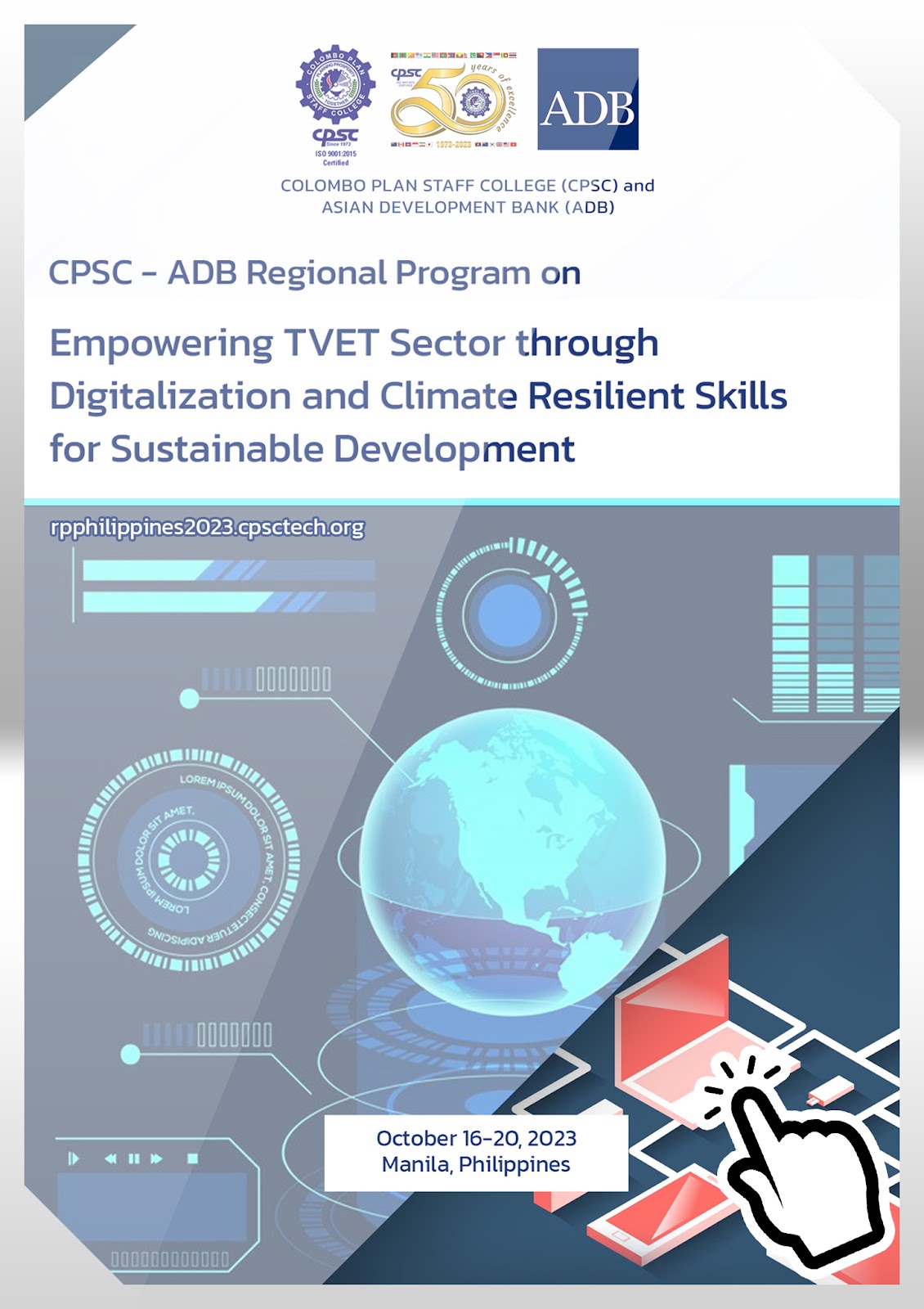
Empowering TVET Sector through Digitalization and Climate Resilient Skills for Sustainable Development

Date: October 16-20, 2023 /
Program Type: Regional Program /

Main Contents


Presentations on:

  • Special Lecture 1: TVET Institutes Management for Global Competitiveness

10th ADB International Skills Forum

  • A new Era of Digitalized and Climate Resilient Human and Social Development

Exercises and workshops on the following:

  • SWOT Analysis for 21st Century
  • Country based Challenges Presentations based on Conference Topics

Objectives

At the end of the program, participants should be able to:

  • Understand the integration of digital literacy into the latest TVET trends to empower diverse learners with essential digital skills for active participation in the digital economy.
  • Emphasize climate resilient skills and green technologies in TVET programs to prepare learners for environmental sustainability and climate challenges.
  • Examine the integration of sustainability principles across all TVET disciplines to foster environmentally conscious practices.
  • Explore the collaboration with industries to design TVET programs that equip learners with relevant digital skills for enhanced employability.
  • Comprehend the new era state-of-the-art Digital Skills Academies which are providing comprehensive digital training and competence development.
  • Observe specialized centers for hands-on training in sustainable practices, renewable energy, and climate resilience.
  • Promote an entrepreneurial culture in the TVET sector by offering courses and workshops on innovation and business development.
  • Explore a community-centric approach to tailor TVET programs to address region-specific challenges and promote positive impact.
  • Understand the benefits of providing equal opportunities for all learners, promoting gender equity and social inclusion within the TVET sector.
  • Examine Data-driven mechanisms to explore the program impact, enabling continuous adaptation and relevance in Country perspective.

Capacity Building on Entrepreneurship Development as a TVET Goal

Date: August 14-18, 2023 /
Program Type: Customize Program

Main Contents

To achieve the objectives set forth, the following strategies will be employed in a consultative nature:

  • Theme Papers & Presentations on the following:
    • Presentation 1: Understanding Entrepreneurship Development as a TVET Goal
    • Presentation 2: Excellence in TVET and Entrepreneurship as an Added Road to Academia
    • Presentation 3: Designing Entrepreneurship Development Program in TVET
    • Presentation 4: Social and Rural Entrepreneurship
    • Presentation 5: Experience Sharing on Best Practices on Entrepreneurship Development in TVET in Some Countries in Asia
  • Exercises and workshops on the following:
    1. GWA 1: TBC
    2. GWA 2: Situational Assessment: a diagnostic framework on collaboration between TVIs and industry as added route to entrepreneurship
    3. GWA 3: TBC
    4. GWA 4: Action Planning on Initiating Establishment of Entrepreneurship Development Program in TVET Schools
    5. Action Plan: Presentation by Participants

Training Needs Analysis (TNA) in the TVET Sector

Date: March 27-31, 20223 /
Program Type: Open Registration Program /

Program Contents

To achieve the objectives set forth, the following strategies will be employed in a consultative nature:

Presentations and workshop on the following:

Theme Papers

  • Theme Paper 1: Introduction to TNA
  • Theme Paper 2 : The Need for TNA
  • Theme Paper 3 : TNA Method
  • Theme Paper 4: Training Development Roles and Responsibilities
  • Theme Paper 5: Methods of Assessing Training Needs
  • Theme Paper 6: Evaluation of Training Outcomes

Group Work Activities (GWA)

  • GWA 1: Participants’ Engagement and Understanding on the Current Practices in TNA
  • GWA 2: SWOT for TNA
  • GWA 3: Designing a TNA Checklist
  • GWA 4: Annual Training Plan by Category and Budget
  • GWA 5: TNA Framework

Expected Outcomes and Outputs

The expected outcomes of the Program are:

  • Design, develop, and implement effective training using TNA tools delivered in the course
  • Institutional capacity on designing of Annual Training Planner will be strengthened effectively

The expected outputs of the Program are to:

  • Develop a Training Needs Analysis Checklist
  • Perform SWOT and Fishbone Diagram Analysis on issues on Attitude, Skill and Knowledge
  • Design the training needs and requirements using various techniques and methods
  • Evaluate the training needs
  • Prepare an effective Training Plan

Research Methodology for TVET Leaders and Teachers

Date: March 13-17, 20223 /
Program Type: In-Country Program /

Program Contents

To achieve the objectives set forth, the following strategies will be employed in a consultative nature:

Presentations and workshops:

Theme Papers (TP)

  • Special Lecture: An Overview of Research Methodology
  • Theme Paper 1: Introduction to Research
  • Theme Paper 2: How to perform Literature Review
  • Theme Paper 3: Basic Research Methodology in Non -Engineering
  • Theme Paper 4: Basic Research Methodology in Engineering
  • Theme Paper 5: Basic Research Planning using K-Chart Approach
  • Theme Paper 6: Basic Publication Planning using K-Chart Approach
  • Theme Paper 7: Basic Result and Analyzing tools in Scientific Research

Group Work Activities (GWA)

  • GWA 1: Research Planning using K-Chart Approach
  • GWA 2: Performing and Experiencing K-Chart Planning
  • GWA 3: An Overview on Research Methodology Workshop
  • GWA 4: Action Plan-Basic Scientific Research Proposal Framework

Objectives

At the end of the course, participants should be able to:

  • To determine and understand the fundamental concept of Research Methodology
  • To understand and apply the methods of Research Methodology
  • Too familiar with the Scientific Process and Beyond in Research Methodology

TVET Institute Management for Global Competitiveness

Date: November 28-December 2, 2022 /
Program Type: Customized Program /

Main Contemts


The delivery of the program design follows a spiral learning approach, begins with an overview of core concepts to be followed by progressively deeper application of the concepts and finally, a self-directed learning approach through action planning.

The main contents of the program are:

Special Lecture

  • Popularizing TVET: Concepts, Strategies and Mechanisms

Presentations

  • Presentation 1: TVET Institutes Management for the Global Competitiveness
  • Presentation 2: CBT Curriculum Approach in TVET
  • Presentation 3: CBT and Assessment System in TVET
  • Presentation 4: Developing a Curriculum Structure Integrating 21st Century Skills and IR 4.0
  • Presentation 5: Enhancing Employability of Youth for Global Citizenship
  • Presentation 6: Application of ICT and Digital Skills in Institutional Management and Teaching
  • Presentation 7: Developing ICT Tool or Mobile App for Teaching and Learning
  • Presentation 8: National Skills Information System, its Application & Benefits
  • Presentation 9: Digitization in MIS and M&E
  • Presentation 10: Excellence of Leadership for Change Management Through PDCA Cycle in TVET Institution

Expected Outcome

  • Manage TVET institutions effectively and efficiently with 21st century management competencies

Objectives


Generally at the end of the program, the participants are expected to enhance their supervisory competencies and be able to:

  • Supervise implementation of quality standards and procedures
  • Facilitate the promotion of programs and services

Specifically at the end of the program, the participants will be able to:

  • Equip knowledge and skills to adapt appropriate strategies in managing TVET and formulate actionable plans to enhance TVET systems and processes in their institution
  • Promote technical cooperation among TVET institutions on the different programs related to Industry Revolutions 4.0
  • Identify the challenges encountered in each TVET institution in terms of management and leadership as they adapt the IR 4.0

Research in TVET

Date: November 3-4, 2022 /
Program Type: Customized Program /

Main Contents

Meeting/Workshop Strategies

To achieve the objectives set forth, the following strategies will be employed in a consultative approach:


  • Theme paper presentations on the following:
    • Understanding the Research Problem
    • Overview of the Research Process in TVET
    • Creation of a Research Proposal
  • xercises and workshops on the following:
    • Workshop on the appreciation of the Research Process in TVET
    • Workshop on the appreciation of the Research Process in TVET

    Inputs

  • Lesson Plans and Program Modules
  • Draft Research Proposal
  • Situation paper of the research status in their respective TVET institutes
  • Handouts and theme paper presentations
    • Understanding the Research Problem
    • Overview of the Research Process in TVET
    • Creation of a Research Proposal

    Expected Outputs

    The meeting cum workshop activities are directed towards the formulation of a research proposal per program, which will be ready enough for implementation as a full-blown research.


  • Readiness of TVET for IR 4.0

    Date: November 29 - December 3, 2021 /
    Program Type: Online In-Country Program /

    Main Contents

    1. TVET 4.0 to Address IR 4.0 covering: 21st Century skills; Skills and Enablers in TVET 4.0
    2. Concepts of IR 4.0, Stages,elements and major trends impacting on TVET 4.0. It shall cover inputs to Teacher Training as well as TVET Research as a Driver for Innovation
    3. TVET Teacher Professional Competency Framework in the Industry 4.0 Era. The VOCTECH SEAMEO Survey will be presented as a case; ASEAN Teaching Model IR 4.0; latest demand-driven occupations and the integration of digital technologies in teaching competencies

    Theme Papers


    • Theme Paper 1: Imagineering TVET for the Changing World
    • Theme Paper 2: Concepts of IR 4.0, Stages, elements and major trends impacting on TVET 4.0.
    • Theme Paper 3: Challenge of Industry 4.0 to Teacher Training and to TVET Research as a Driver for innovation
    • Theme Paper 4: TVET Teacher Professional Competency Framework in the Industry 4.0 Era
    • Theme Paper 5: Digital Technologies to Integrate IR 4.0 Skills inTeaching Competencies

    Group Work


    • Group Work 1: Gap Analysis /SWOT Analysis: Overview of the Current TVET Landscape
    • Group Work 2: Developing Teaching Aids for a Blended Learning Program
    • Group Work 3: Developing Digital Contents Using Authoring Tools
    • Group Work 4 : System Development Planning: Action Plan The Way Forward

    Orientation on Updated APACC Self Study Form and Processes

    Date: November 4-5, 2021 /
    Program Type: Online Program /

    Main Contents

    Presentations:


    • APACC Processes and Updates
    • Rationale and Overview of Updates on APACC Instrument and Procedures
    • Criterion 1: Governance and Management
    • Criterion 2: Teaching and Learning
    • Criterion 3: Human Resources
    • Criterion 4: Research and Development
    • Criterion 5: Image and Sustainability
    • Criterion 6: Other Resources
    • Criterion 7: Support to Students