Showing posts with label Myanmar. Show all posts

Leadership Capacity Building for TVET Professionals

Date: June 22-26, 2026 /
Program Type: In-Country Program /

OBJECTIVES

  • Strengthen leadership and management skills for effective TVET governance
  • Enhance institutional governance and policy implementation through APACC QA 2025 Framework
  • Improve collaboration between TVET institutions and industry
  • Integrate innovative and digital tools into TVET teaching and administration
  • Promote green, sustainable, and inclusive TVET systems
  • Develop institutional leadership action plans for continuous improvement

PROGRAM CONTENTS

Theme Papers:

  • Theme Paper 1: Transformational Leadership in TVET Institutions
  • Theme Paper 2: Strengthening TVET-Industry Collaboration for Workforce Alignment
  • Theme Paper 3: Public-Private Partnerships and Work-Based Learning Models in TVET
  • Theme Paper 4: Digital Leadership and Innovation in TVET Institutions
  • Theme Paper 5: Future-ready skills & digital Competency framework
  • Theme Paper 6: Green TVET and Sustainable Development Practices
  • Theme Paper 7: Inclusive TVET Leadership

Workshops/Group Work Activities:

  • Workshop 1: Institutional Governance Gap Analysis using APACC Principles
  • Workshop 2: Mapping Industry Needs with TVET Programs
  • Workshop 3: Designing Institutional Industry Engagement Strategies
  • Workshop 4: Exploring Digital Tools for TVET Teaching and Administration
  • Workshop 5: Developing Digital Transformation Roadmaps
  • Workshop 6: Integrating Greening & Sustainability into TVET Programs
  • Workshop 7: Designing Inclusive Institutional Strategies
  • Workshop 8: Drafting individual institutional Action plans: Strategic Leadership and Change Management in TVET for future-ready TVET Institutions toward IR 5.0

Entrepreneurship / Technopreneurship Development in TVET

Date: March 17-21, 2025 /
Program Type: In-Country Program /

Program Contents

Special Lecture on“Entrepreneurship and Technopreneurship Development in TVET in the Asia-Pacific Region”

Theme Papers & Presentations on the following:

  • Theme Paper 1: Introduction to Entrepreneurship and Technopreneurship
  • Theme Paper 2: Curriculum Development for Entrepreneurship
  • Theme Paper 3: Curriculum Development for Technopreneurship
  • Theme Paper 4: Technopreneurship and Emerging Technologies
  • Theme Paper 5: Creating an Entrepreneurial Ecosystem in TVET Institutions
  • Theme Paper 6: Assessment and Evaluation of Entrepreneurship Skills

Workshops & Activities

  • Workshop 1: Curriculum Design Simulation
  • Workshop 2: Institutional Ecosystem Design Workshop
  • Workshop 3: Designing Project Rubrics
  • Task Exercise: Building an Entrepreneurial Mindset
  • Action Plan: Development of an Action Plan on Sustainability of Entrepreneurship in TVET System of Myanmar

Objectives

The objectives of the ICP on “Entrepreneurship/Technopreneurship Development in TVET” are to:

  • Strengthen TVET Capacity for Entrepreneurship Education
    Enhance the capacity of TVET educators and curriculum developers in designing and delivering entrepreneurship and technopreneurship education, aligning with SDG 4 (Quality Education) and SDG 8 (Decent Work and Economic Growth).
  • Foster an Entrepreneurial Mindset in TVET
    Explore innovative teaching methodologies and emerging technologies to cultivate creativity, innovation, problem-solving, risk-taking, resilience, and adaptability among TVET learners, in line with SDG 9 (Industry, Innovation, and Infrastructure).
  • Develop Business and Technopreneurial Competencies
    Equip TVET students with essential business skills, including business planning, financial management, marketing, and the use of digital tools and emerging technologies for business growth, supporting SDG 4 and SDG 8.
  • Create an Institutional Ecosystem for Entrepreneurship
    Develop supportive structures within TVET institutions for entrepreneurship and technopreneurship initiatives, including business incubation models that empower students and graduates to launch sustainable ventures (SDG 8 and SDG 9).
  • Integrate Entrepreneurship into TVET Curricula
    Formulate actionable strategies to embed entrepreneurship education into TVET curricula, ensuring its relevance to modern economic and technological trends (SDG 4 and SDG 8).
  • Promote Social and Sustainable Entrepreneurship
    Advocate for green business models and sustainable economic practices while fostering social enterprises that address community challenges, contributing to SDG 12 (Responsible Consumption and Production) and SDG 13 (Climate Action).

Empowering Workforce and Gender Inclusivity: Navigating the TVET Landscape Through Digitalization and Green Practices

Date: July 8-12, 2024 /
Program Type: Regional Program /

Main Contents

The Participants are expected to gain comprehensive knowledge to enhance their capacity towards empowering workforce and gender inclusivity by navigating the TVET landscape through digitalization and green practices


Program/Conference Strategies

To achieve the objectives set forth, the following strategies will be employed in a consultative nature:

Theme Papers & Presentations on the following:

  • Special Lecture-1: Empowering Workforce through TVET Landscaping: Strategies for Success
  • Theme Paper 1: Beyond the Classroom: Uniting Education and Industry for Future-Ready TVET Programs
  • Theme Paper 2: Synergizing Industry and Education: Cultivating Dynamic Partnerships for TVET Excellence
  • Theme Paper 3: Digital Revolution: Understanding the impact of digitalization on TVET
  • Theme Paper 4: Digitalization in TVET: Tools and Strategies for Transformation
  • Theme Paper 5: Exploring effective strategies for integrating digitalization into TVET curricula and training programs
  • Theme Paper 6: The Importance of Green Skills in Sustainable Development
  • Theme Paper 7: Strategies & Practical Approaches for Greening Campuses

Exercises and workshops on the following:

  • Bridging the Gap Between Employers and TVET Institutions for Enhanced Workforce Preparedness through NSIS
  • Digital tools and technologies transforming TVET, including online platforms, virtual simulations, and interactive modules

Objectives

The participants are expected to:

  • Understand the concept of empowerment and inclusivity in TVET through digitalization and green practices
  • Appreciate the need and importance of accessibility and personalized learning experiences in TVET through digital platforms programs and institutions to respond to the national, regional, and global labor market
  • Understand the gender diversity and equality in traditionally male-dominated fields
  • Comprehend the steps involved in how to equip individuals with skills for a greener economy and society
  • Cultivate a culture of sustainability and responsibility among TVET learners.
  • Create a discussion opportunity and experience sharing for a prosperous and sustainable future in member countries through investment in digital infrastructure and green practices in TVET.
  • Break down barriers and create pathways for women in technical and vocational fields.

Enhancing Quality Management System in TVET

Date: June 24-28, 2024 /
Program Type: In-Country Program /

Main Contents

To achieve the objectives set forth, the following strategies will be employed in a consultative nature:

Theme Papers & Presentations on the following:

  • Special Lecture: Benchmarking Quality Assurance of TVET Institutions
  • Theme Paper 1: Overview of TVET Quality Assurance System by Myanmar
  • Theme Paper 2: Quality Management System in TVET as Key to Train Skilled Workforce
  • Theme Paper 3: Quality Assurance in TVET using the EAS TVET QAF
  • Theme Paper 4: Principles and Guidelines for QMS in TVET
  • Theme Paper 5: Quality Management Tools and Implications in TVET Institutions
  • Theme Paper 6: Application of PDCA for Quality Management
  • Presentation 1: Quality Management in Governance and Management
  • Presentation 2: Quality Management in Teaching and Learning
  • Presentation 3: Quality Management in Human Resources
  • Presentation 4: Quality Management in Research and Development
  • Presentation 5: Quality Enhancement in Image & Sustainability
  • Presentation 6: Quality Assurance in Other Resources of TVET Institute

Exercises and workshops on the following:

  • Conduct a SWOT Analysis on the Institutional Quality Assurance
  • Identification of Major Issues & Challenges in Maintaining a Quality Assurance System
  • Workshop on M&E for QMS in TVET Institutions
  • Workshop on How to Ensure Quality Support to Students

Objectives

The participants are expected to:

  • Understand the concept of Quality Assurance System
  • Appreciate the need and importance of accreditation and certification of TVET programs and institutions to respond to the national, regional, and global labor market
  • Understand the nature and significance of various criteria and parameters used for accreditation as a tool for improving the quality of TVET Institutions
  • Comprehend the steps involved in the process of accreditation
  • Prepare the documents needed for submission to accrediting agencies
  • Create a discussion opportunity and experience sharing for the institute representatives aimed to exchange relevant information on how to enhance quality assurance offerings in TVET for their institute

Research Methodology for TVET Leaders and Teachers

Date: June 19-23, 2023 /
Program Type: In-Country Program /

Main Contents

To achieve the objectives set forth, the following strategies will be employed in a consultative nature:

Presentations on the following:

Theme Papers

  • Theme Paper 1: Introduction to Research
  • Theme Paper 2: Literature Review Performance
  • Theme Paper 3: Basic Research Methodology
  • Theme Paper 4: Data Analysis in Research
  • Theme Paper 5: Current Trend in Workforce TVET
  • Theme Paper 6: Competency and Strategies to meet Myanmar Workforce in TVET
  • Theme Paper 7: Research Methodology approach using K-Chart Technique.
  • Theme Paper 8: Research Publication – Journal, Citation and References

Exercises and workshops on the following:

Group Work Activities (GWA)

  • GWA 1: Workshop on Research Methodology
  • GWA 2: Workshop on Data Analysis
  • GWA 3: Issues and concern - Workforce in TVET
  • GWA 4: Basic Proposal on Workforce in TVET

Objectives

At the end of the course, participants should be able to:

  • Determine and understand the fundamental concept of Research Methodology
  • Familiarize and understand the research framework
  • Understand the demand for workforce in TVET via Research Methodology techniques

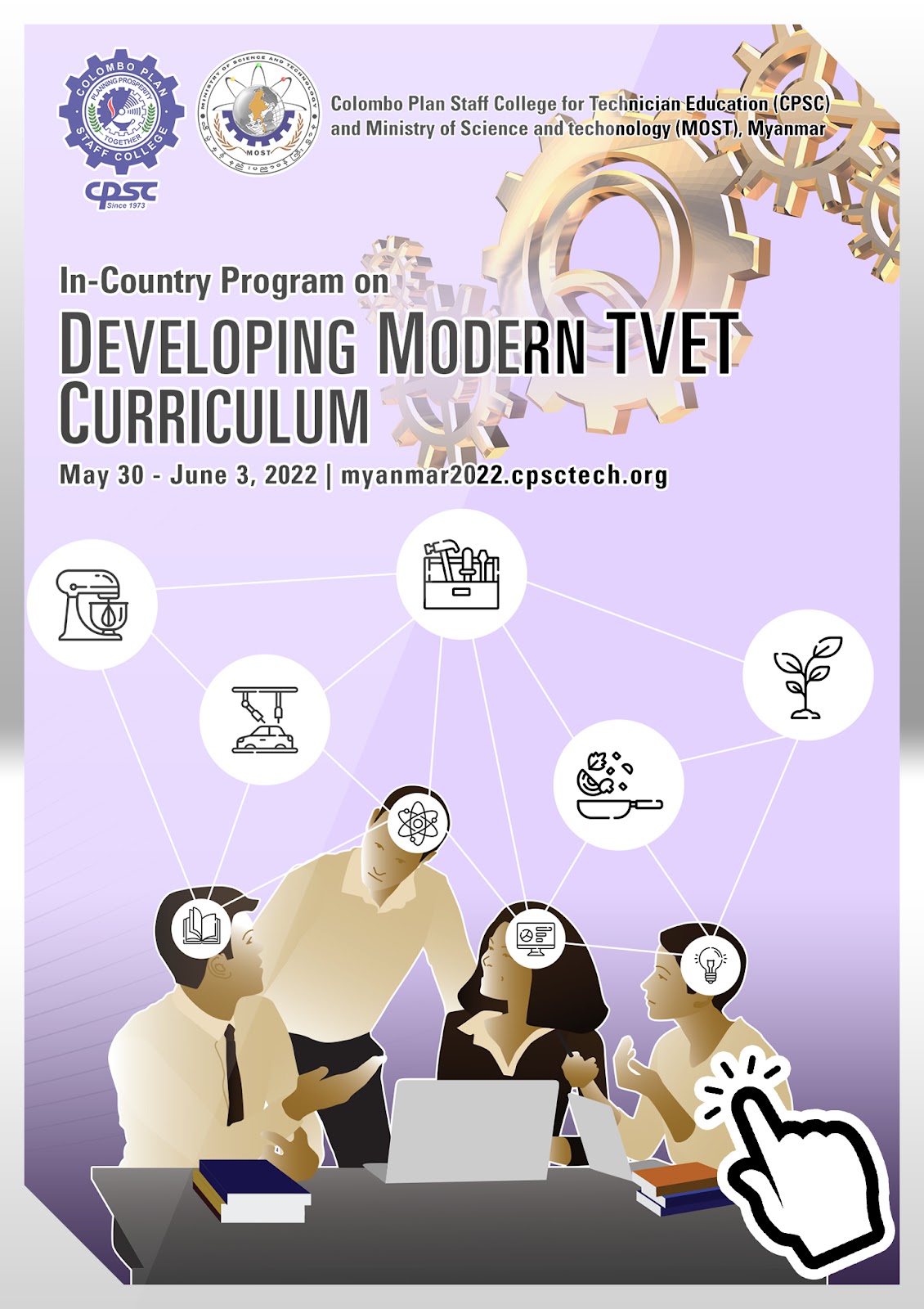
Developing Modern TVET Curriculum

Date: May 30 - June 3, 2022 /
Program Type: In-Country Program /

Main Contents

Special Lecture: Skills Development for the Post-COVID Digital Economy. This special lecture will contribute to ongoing discussions on how the pandemic and emerging technologies are transforming job markets, determining new skills sets requirements and driving the digital economy.


Theme Papers


  • Theme Paper 1: Understanding Competency-Based Training. The first theme paper provides an overall understanding of key CBT concepts and practices. Definitions of competence, qualifications, and qualifications framework as well as CBT processes and structures will be discussed.
  • Theme Paper 2: Identifying Priority Occupations. The second theme paper discusses this first stage of CBT and its two steps: skills needs assessment and training needs analysis. Skills needs assessment identifies the differences between the skills required – by whom, for what job, for which product or service market, in what quantity, and when – and the training available – for which population, at what cost, for what job and for which product or service market. Training needs analysis refer to the technical and vocational skills gaps that need to be addressed to employment in the labour market.
  • Theme Paper 3: Identifying competencies. The third theme paper explains the three-step process of identifying the competencies and competency standards that will later be used by learners and training providers. The steps include: (a) identifying competencies using occupational analysis; (b) verifying the occupational profile; and (c) developing competency standards.
  • Theme Paper 4: Designing CBT Programmes. The fourth theme paper illustrates the actual processes of designing CBT programmes. The paper describes the procedures of developing curriculum and learning tools as well as the designing CBT for workplace-based learning
  • Theme Paper 5: Developing a Curriculum Framework. The fifth theme paper explains how competency standards are transformed into a curriculum framework. The framework consists of the module design with learning outcomes and content, teaching and learning strategies, assessment criteria and modes of assessment. The paper also details the translation of the curriculum framework into learner guides that will form the basis of training delivery. Instructions on designing job sheets and session plans will also be tackled in this paper.

Group Work


  • Group Work 1. Brainstorming on the Implications of the Digital Economy Megatrends to Skills Demand and Supply
  • Group Work 2. Developing a DACUM Chart
  • Group Work 3. Writing a Unit of Competency
  • Group Work 4a. Writing Program Design
  • Group Work 4b. Writing Learning Outcomes
  • Group Work 4c. Developing Learning Tools
  • Group Work 5: Presenting the Curriculum Framework

Enhancing TVET Institution and Industry Partnerships for Quality TVET

Date: July 24-28, 2021 /
Program Type: Online In-Country Program /

Main Contents

Online Classes


  • Special Lecture: Post COVID-19 Scenario for Industry Institute Partnership
  • Theme Paper 1: From linkages to Industry-Institution Partnerships in TVET System: Concepts and Principles
  • Theme Paper 2: Innovative Models and Approaches in TVET Industry - Institute Partnership
  • Theme Paper 3: Dual Training System: Concept, Benefits, and Challenges
  • Theme Paper 4: Industry-Institution linkages in TVET system of Myanmar
  • Theme Paper 5: I-I Partnership in Curriculum development and Training programs
  • Theme paper 6: Action Planning for Institute-Industry Partnership for quality TVET

Group Works


  • Group Work 1: Undertake SWOT analysis for Industry - Institute Partnership in the TVET system
  • Group Work 2: Develop strategies for enhancing industry-institution partnership system in the TVET sector
  • Group Work 3: Identify Responsibilities of Institute Management Committee for I-I linkages
  • Group Work 4: Identify the Characteristics of the Best I-I partnership model that suits the Myanmar Context
  • Group Work 5: Preparation of Action Plan for building industry-institute Partnerships in the TVET system


National Seminar on
Public-Private Partnerships: As an Expanding Horizon for Institute-Industry Partnership TVET System of Myanmar
July 26, 2021

View Seminar Brochure

Seminar Presentations

Application of Blue Ocean Strategy for TVET Institute Management

Date : Nov 18-22, 2019 /
Venue : Yangon, Myanmar /
Program Type: In-Country Program /

Main Contents

Theme Papers
  • Special Lecture: TVET For Global Competitiveness: Fostering 21st Century Skills
  • Theme Paper 1: Concepts, principles and importance of Blue Ocean Strategy
  • Theme Paper 2: Curriculum development to address future market demand
  • Theme Paper 3: Teaching and learning environment of TVET institute based on blue ocean strategy
  • Theme Paper 4: Leadership for change management to address blue ocean strategy
  • Theme Paper 5: Relevance of blue Ocean Strategy with post training aspects like employment, entrepreneurship


Group Work
  • Group Work 1: Critical Issues Identification & SWOT Analysis for BOS
  • Group Work 2: Analysis of existing curriculum with blue ocean perspective
  • Group Work 3: Case study on teaching & learning environment of other countries based on IR 4.0 and greening TVET
  • Group Work 4: Self-assessment on leadership traits
  • Group Work 5: Preparation of Action Plan for Building Effective Blue Ocean Strategy in TVET System of Myanmar.


National Seminar: Greening TVET

Quality Assurance through Results Based Monitoring and Evaluation


Date : May 15-18, 2018 /
Venue : CPSC, Manila, Philippines /
Program Type: Customized Program /

Main Contents

Theme Papers:
  • Theme Paper 1: Overview of M&E in Educational Institutions based on Strategic Plan, project document and operational plan
  • Theme Paper 2: Process and Methods of M&E
  • Theme Paper 3: Development of M&E Plan (stakeholders analysis, communication and risk assessment)
  • Theme Paper 4: M&E tools and techniques in Educational programs and projects
  • Theme Paper 5: Management of M&E (HRD, execution, analysis of result, reporting, feedback)

Group Work Activity:
  • Workshop 1: Prepare M&E Plan

Industry - Academia Collaboration & Partnership


Date : May 7-11, 2018 /
Venue : DTVE – South Branch Office, Yangon, Myanmar /
Program Type: In-Country Program /

Main Contents

The delivery of the program design follows a spiral learning approach, beginning with an overview of core concepts and followed by progressively deeper application of the concepts and finally a self-directed learning approach through action planning.


Part 1


  • Special Lecture: Emerging Trends in the Colombo Plan Region: CPSC’s Response

Part 2


Module 1: Introduction to Industry-Academia Collaboration and Partnership for TVET System

  • Building Industry-Academia Collaboration and in TVET System
  • Facilitating and Restraining Factors in Fostering Industry-Academia Collaborations and Partnership

Module 2: Developing Industry-Academia Collaboration and Partnership in TVET System

  • Innovative Models and Approaches in Industry-Academia Collaboration and Partnership
  • Developing Strategies for Enhancing Industry-Academia Collaboration and Partnership in TVET System
  • Stimulating Entrepreneurship Education in TVET System

Panel Discussion: Developing Industry-Academia and Government Collaboration: A Game-Changer for 21st Century Workforce Development


Project Work and Action Plan

  • Developing Industry-Academia Partnership System in TVET Sector
  • Preparation of Action Plan for Building Industry-Academia Collaboration and Partnership in TVET System

National Seminar on Quality Assurance in TVET: Emerging Trends and Fresh Perspectives

Strategic Planning of TVET Institutions in Myanmar


Date : Jan. 12-16, 2015 /
Venue : Department of Technical and Vocational Education (Southern Branch), Yangon, Myanmar /
Program Type: In-Country Program /
Collaborating Organization: Department of Technical and Vocational Education (DTVE) and Ministry of Science and Technology, Myanmar /

The delivery of the program design shall follow a spiral learning approach, beginning with an overview of core concepts and followed by progressively deeper application of the concepts and finally, a self-directed learning approach through action planning.

The main contents of the in-country program are:

Theme Papers:

  • Theme Paper 1: Management concepts and paradigms of improving Institutional Managements in TVET systems
  • Theme Paper 2: Strategic Planning and Management Process for Institutional Management of TVET Systems
  • Theme Paper 3: ICT for Teaching and Learning in TVET systems
  • Theme Paper 4: Accreditation and Certification of TVET Institutions through APACC process for Quality Assurance
  • Theme Paper 5: Implementation, monitoring and evaluation method and tools for TVET institution management

Tasks:

  • Task 1a: Assess Quality of Institutional Functions
  • Task 1b: Stakeholder Identification, Organizational Vision and Mission Identification
  • Task 2: Critical Issues Identification & SWOT Analysis
  • Task 3: Crafting the Strategic Vision, creating a Mission statement, Constructing Goals and Composing the SMART Objectives & Presentation
  • Task 4: Preparation of Documents for APACC for Quality Assurance

Project Task: Action Planning for Strategic Planning of TVET Institution

National Seminar

Another important part of the program is the conduct of the half day National Seminar on "Emerging Trends for Institutional Management of TVET Systems in Myanmar" which will be participated by In-Country Program participants, DTVE officials, faculty members, media, public relations officers in both public and private sectors and other interested participants