Showing posts with label Thailand. Show all posts

Promoting Green Research, Green Skills, Sustainability & Inclusiveness in the TVET System of Asia-Pacific Countries

Date: February 23-27, 2026 /
Program Type: Regional Program /

Program Contents

The program consists of the following major learning components:

SPECIAL LECTURE: Accelerating Green Transformation and SDGs through Green TVET and Sustainable Human Capital Development (Prof. (Dr.) Suresh K. Dhameja)
Purpose: Introduce core rationale and regional relevance

THEME PAPERS:

  • Theme Paper 1: Green Skills and Green Competencies for the Future Workforce in Asia-Pacific TVET
  • Theme Paper 2: Green Research and Innovation Culture in TVET Institutions
  • Theme Paper 3: TVET Institutions as Drivers of the BCG Economy in Thailand and Asia-Pacific (Institutional Practices, BCG sector skills, Circular Economy, and Thailand’s national model)
  • Theme Paper 4: Transforming TVET Systems for Sustainability and Climate Resilience (Policy, Governance, Systems Transformation & Regional Frameworks)
  • Theme Paper 5: Digitalization, AI, and Smart Technologies for Sustainable TVET
  • Theme Paper 6: Inclusive, Equitable and Digitally-Enabled Green TVET: Aligning Institutional Practices with APACC’s Green Standards and Regional Benchmarks

WORKSHOPS:

  • Workshop 1: Designing Green and Sustainable TVET Curriculum Modules
  • Workshop 2: Green Innovation Challenge: Designing Low-Cost Sustainable Technology Projects
  • Workshop 3: Digital Tools for Sustainability: Developing a Tech-Integrated Green Lesson Plan
  • Workshop 4: Action Planning: Introduction to Green Action Plan Framework
    • Institutional Problem Mapping
    • Drafting institutional Goals and Indicators

Integrating Entrepreneurship and Technopreneurship in TVET Curriculum

Date: January 26-30, 2026 /
Program Type: In-Country Program /

Program Contents

Special Lecture: Achieving UN-SDGs through Entrepreneurship and Technopreneurship Development in TVET (Prof. (Dr.) Suresh K. Dhameja)
Purpose: Introduce core rationale and regional relevance

Theme Papers

  • Theme Paper 1: Building Sustainable Business Ventures in TVET Green Innovation and Circular Economy (Mrs. Vibeke Lyssand LeirvĂ„g)
  • Theme Paper 2: Entrepreneurial Intelligence: The Role of Mindset, Resilience, and Risk Literacy in TVET Education (Prof. Heidi Uy)
  • Theme Paper 3: Technopreneurship in the Digital Economy: Opportunities for TVET Learners (Prof. Heidi Uy)
  • Theme Paper 4: Environmental Scanning and Business Opportunity Identification (Prof. (Dr.) S.K. Dhameja)
  • Theme Paper 5: From Craftsmen to Creators: Transforming Traditional Vocational Skills into Scalable Innovative Enterprises (Prof. Heidi Uy)
  • Theme Paper 6: Financing Innovation: Strategic Policies and Institutional Support by Banks/Financial Institutions for Entrepreneurs (Mr. Weerachai Tanglamlert)

Group Work Activities (GWA)

  • GWA 1: A. Design Thinking Challenge – Innovate a TVET Product/Service
    B. Business Model Canvas & Innovation Mapping Workshop (Each group may prototype their individual business idea) (Prof. Heidi Uy)
  • GWA 2: Tech Integration Mapping for TVET Specializations (Prof. Heidi Uy)
  • GWA 3: Action Planning: Integrating Entrepreneurship and Technopreneurship in TVET Curriculum of Thailand (Prof. (Dr.) Suresh K. Dhameja)

Digital Embracement for the Future in VR, AR, and MR in TVET

Date: January 27-31, 2025 /
Program Type: In-Country Program /

Main Contents

To achieve the objectives set forth, the following strategies will be employed in a consultative manner:

Theme papers and presentations on the following:

  • Special Lecture: Achieving the United Nations (UN) Sustainable Development Goals (SDGs) through TVET
  • Presentation 1: The Future of TVET by Harnessing the Power of VR, AR, and MR
  • Theme Paper 1: Bridging the Skills Gap with Immersive Learning Technologies
  • Theme Paper 2: Designing the Classroom of Tomorrow: Integrating VR, AR, and MR in TVET
  • Theme Paper 3: Overcoming Barriers: Implementing Immersive Technologies in TVET
  • Theme Paper 4: The Role of Immersive Technologies in Ensuring Safety and Efficiency in Training
  • Theme Paper 5: Beyond the Headset: Exploring the Next Frontier in Immersive Technologies
  • Theme Paper 6: The Ethical and Social Implications of Immersive Technologies in TVET

Exercises & workshops:

  • Workshop 1: TVET Institute for Next Generation Environment
  • Workshop 2: Crafting Immersive Learning Content for TVET: Tools and Techniques
  • Workshop 3: Preparing Educators' Framework for the Digital Shift in TVET

Objectives

The program aims to empower participants with knowledge and practical insights into leveraging Virtual Reality (VR), Augmented Reality (AR), and Mixed Reality (MR) in Technical and Vocational Education and Training (TVET). It seeks to enhance skills development, promote sustainable training practices, and foster collaboration among educators, industry leaders, and policymakers for future-ready workforce preparation.

The participants are expected to:

  • Understand the significance of VR, AR, and MR in modernizing TVET programs.
  • Explore the role of immersive technologies in enhancing experiential learning.
  • Learn how to integrate VR, AR, and MR into diverse vocational training curricula.
  • Analyze successful global case studies of digital transformation in TVET.
  • Develop strategies to address challenges in adopting immersive technologies.
  • Foster collaboration to build a sustainable and inclusive TVET ecosystem.

Change Management for TVET

Date: June 10-14, 2024 /
Program Type: In-Country Program /

Main Contents

To achieve the objectives set forth, the following strategies will be employed in a consultative nature:

Theme Papers & Presentations on the following:

  • Presentation 1: Concept and Guiding Principles of Change Management
  • Presentation 2: Strategies and Tools to Address Change Management in TVET Institutes
  • Session 1: TESDA & Management Operational Overview
  • Session 2: Empowering Change: Women Driving Diversity and Inclusion in TVET Education
  • Session 3: Toyota Production System
  • Session 4: Manufacturing Quality Assurance

Exercises and workshops on the following:

  • Self-assessment of Change Competency Leadership
  • Application of Change Management Tools in Problem Resolution

Field Visits on the following:

  • SEAMEO Innotech Philippines
  • TESDA Philippines
  • TWC Institute Philippines
  • Toyota Institute Philippines

Symposium on ‘Strengthening Skills Through Multilateral Cooperation: A Retrospective on the 75 Years of Diplomatic Relations Between Thailand and the Philippines’

  • Session 1: Digital Transformation in TVET: Leveraging Thai-Philippine Partnerships for Technological Advancement
  • Session 2: Green Technology Integration in TVET: Best Practices of Greening TVET in the Global Context
  • Session 3: Education Innovation for Economic Development & Sustainability
  • Session 4: Inclusive TVET: Promoting Access and Equity Through Multilateral Cooperation

Objectives

The participants are expected to:

  • Understand the concept of Change Management in TVET
  • Equip TVET professionals with strategies to identify and analyze change drivers within TVET educational contexts.
  • Foster a culture of adaptability and innovation among TVET faculty and staff to effectively manage transitions.
  • Enhance stakeholder engagement and collaboration to ensure buy-in and support for change initiatives in TVET programs.
  • Provide tools and techniques for planning, implementing, and evaluating change within TVET institutions.
  • Develop leadership capabilities to guide and facilitate change processes within the TVET environment.
  • Empower TVET practitioners with skills to navigate challenges and capitalize on opportunities arising from industry and societal shifts.

Greening TVET for Sustainable Development

Date: January 29, 2024 - February 2, 2024 /
Program Type: In-Country Program /

Main Contents

To achieve the objectives set forth, the following strategies will be employed in a consultative manner:

Theme papers and presentations on the following:

  • Special Lecture: Greening TVET as an SDG 2030 Strategy: Current Concepts, Practices, and Future Agenda
  • Theme Paper 1: Importance of Green Skills in Sustainable Development
  • Theme Paper 2: Strategies and Practical Approaches for Greening Campuses
  • Theme Paper 3: Integrating Green Skills in the TVET Curriculum
  • Theme Paper 4: TVET Digitization for Global Competitiveness
  • Theme Paper 5: The Future of TVET with IR 4.0 to TVET 4.0
  • Theme Paper 6: Best Practices of Greening TVET in the Global Context

Workshops & Activities

  • Workshop 1: Conduct a SWOT Analysis of the Green TVET Institute Environment
  • Workshop 2: Identification of Major Issues and Challenges in Greening Campuses for Sustainable Development through PESTEL Analysis
  • Workshop 3: Prepare an action plan for the Integration of Green Skills in the TVET institute.

National Seminar on “Greening Skills for Sustainable Development”

  • Session 1: The Role of Education in Fostering Green Mindsets and Skills
  • Session 2: Circular Economy: Redefining Resource Efficiency
  • Session 3: Green Tech Startups: Catalyzing Innovation for a Sustainable Future
  • Session 4: Renewable Energy Transition: Challenges and Opportunities
  • Session 5: Smart Cities: Integrating Sustainability into Urban Planning
  • Session 5: Open Forum

Objectives

The overall objective of the Greening TVET for Sustainable Development training program is to maintain a green society through TVET professionals by empowering students with green knowledge, skills, and attitudes. The specific objectives of the program are to effectively and efficiently analyze emerging trends and challenges in greening TVET for sustainable development for the benefit of future generations.

The participants are expected to:

21st Century Skills for TVET

Date: February 20-24, 20223 /
Program Type: In-Country Program /

Program Contents


To achieve the objectives set forth, the following strategies will be employed in a consultative nature:

Theme Papers & Presentations on the following:

  • Theme Paper 1: TVET Institutes Management for Global Competitiveness
  • Theme Paper 2: 21st Century Skills and IR 4.0 for Global Competitiveness & Innovation in the TVET
  • Theme Paper 3: Developing a Curriculum Structure Integrating 21st Century Skills
  • Theme Paper 4: TVET Digitization for Global Competitiveness
  • Theme Paper 5: IR 4.0 to TVET 4.0
  • Theme Paper 6: Excellence of Leadership for Change Management through PDCA Cycle in TVET

Workshops & Activities

  • Workshop 1: Understanding and Analyzing TVET Institute Image Building with 21st Century Environment through SWOT analysis.
  • Workshop 2: Creating Competency-Based Training (CBT) by integrating 21st Century Skills.
  • Workshop 3: 21st Century Skills Delivery in Real-Time Classroom.

Seminar on “21st Century Skills for Sustainable TVET”

  • Session 1: TVET with 21st Century Skills & the VUCA World
  • Session 2: Green TVET & The National Economy
  • Session 3: TVET Digital Management in 2030
  • Session 4: Open Forum

Objectives

The participants are expected to:

  • Understand the concept of 21st Century Skills and IR 4.0
  • Discuss the importance of 21st Century Skills for TVET
  • Gain knowledge, experience, and skills on 21st Century Skills in developing and designing the curriculum for TVET students
  • Integrate the 21st Century Skills for TVET into the teaching and learning management of TVET
  • Encourage and develop the 21st Century Skills to be suitable for employability in the future.
  • Be familiar with the vocational pedagogy to deliver 21st Century Skills and IR 4.0
  • Develop curriculum framework incorporating 21st Century Skills and IR 4.0
  • Be familiar with ICT & digital technology to integrate 21st Century Skills and IR 4.0 in TVET

Expected Outcomes

The Participants are expected to gain more knowledge experience of 21st Century Skills for TVET in developing and designing the curriculum for TVET students as the 21st Century skills are tools that can be universally applied to enhance ways of thinking, learning, working and living in the world. The skills include critical thinking/reasoning, creativity/creative thinking, problem solving, metacognition, collaboration, communication and global citizenship.

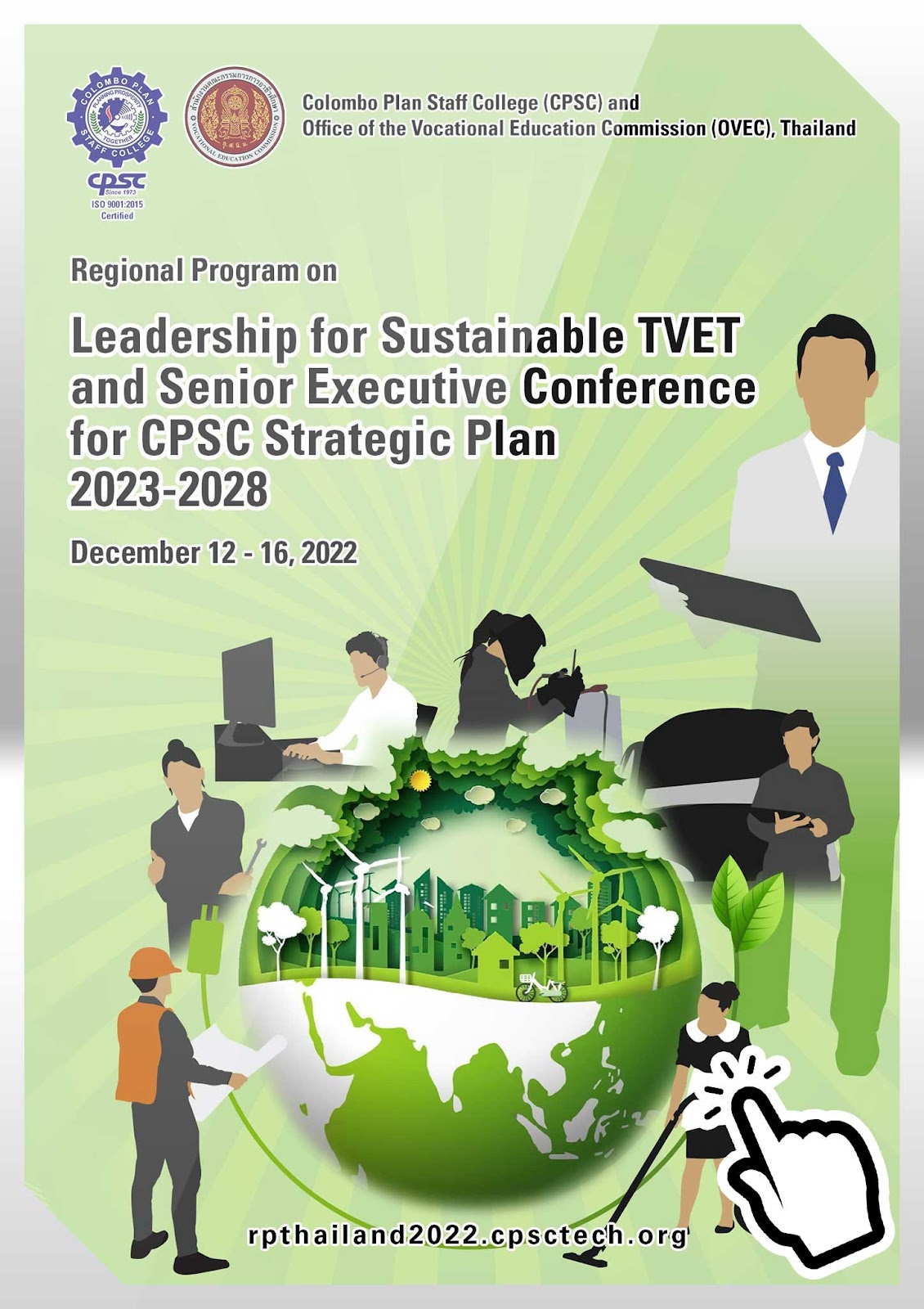
Leadership for Sustainable TVET and Senior Executive Conference for CPSC Strategic Plan 2023-2028

Date: December 12-16, 2022 /
Program Type: Regional Program /

Main Contemts


Objectives

The participants are expected to:

  • Comprehend the role and significance of a strategic plan in the development of national public interest.
  • Understand the role and significance of the CPSC strategic plan’s elements such as vision, mission, strategic goals, and objectives, and be able to identify formulations of those elements that are in line with National requirements.
  • Provide check-and-balance controls for the vision, mission, strategic goals, and objectives drafted by the NCW and expert participants and ensure that the outputs that they review are linked with their national agenda.
  • Provide validation to the Strategic Plan inputs and made by the delegates of the National Consultation Workshop (NCW) and Experts Meeting (EM).
  • Ratify and recommend the Strategic Plan 2023-2028 to the CPSC Governing Board for implementation.

  • Program/Conference Strategies

    To achieve the objectives set forth, the following strategies will be employed in a consultative nature:

    Presentations on the following:

    • CPSC Performance Overview & Strategic Focus
    • CPSC’s Strategic Plan 2018-2023, Highlights and Status Report, and Issues and Challenges for the Future (Softcopy)
    • Sustainable TVET Strategies on a Global Perspective.
    • Country Paper Presentations on TVET Challenges:
      • Skill Migration & TVET Branding (Philippines )
      • TVET Accreditation and Quality Assurance (Malaysia)
      • Digital and Virtual TVET (India)
    • TVET image Building: Singapore’s Success Story
    • Strategies on Transformation to workplace learning for Future-Ready TVET
    • CPSC Strategic plan 2023-2028 Process + Results of the expert Meeting 2022 in Malaysia

    Exercises and workshops on the following:

    • Potential Programs and Expectations for CPSC in View of the Member Countries input requirements
    • Analysis and Synthesis of the National Consultation Workshop, Expert meeting Results and the Crafting of the Activities

    International Seminar on “Leadership & Strategy for Sustainable TVET”

    The international seminar on “Leadership and Strategy for Sustainable TVET” aims to bring together additional participants in order to share and discuss emerging challenges and best practices as shared by selected TVET experts. For this program, experts from Singapore are invited to share their country’s experience and best practices particularly on “Image Building” and “Strategies on Transformation to Workplace Learning for Future-Ready TVET”, with the aim of replicating and learning from the Singaporean model in implementing strategies for Sustainable TVET.

    The seminar will also convene a panel of experts that will further digest and discuss the inputs of the speakers vs the feedback from various invited stakeholders in the event. The panel will also be helpful in contextualizing these inputs into tangible plans of action that will benefit the stakeholders in adapting a careful strategy through the analysis of best practices from other systems.


Project Management in TVET

Date: March 21-25, 2022 /
Program Type: In-Country Program /

Main Contents

Theme Papers


  • Special Lecture: Revisiting Global Trends and Challenges in TVET: Reflections for Project Identification
  • Theme Paper 1: Basics of Project Management
  • Theme Paper 2: Identifying and Conceptualizing Projects
  • Theme Paper 3: Developing the Project Proposal
  • Theme Paper 4: Project Implementation and Monitoring
  • Project Evaluation and Closure

APACC Post Accreditation System

Date: Nov 30 - Dec 2, 2020 /
Program Type: Online In-Country Program /

Main Contents

  • Special Lecture: Quality Management System in TVET as Key to Produce Skilled Workforce
  • Theme Paper 1: Utilizing APACC Evaluation in Charting Institutional Development Through Strategic Planning
  • Theme Paper 2: OVEC Policy on APACC
  • Theme Paper 3: APACC Maintenance and Preparation for Reaccreditation
  • Theme Paper 4: ONESQA Policy on Regional Accredited Institution
  • Theme Paper 5: Integration of ONESQA and APACC Criterion for Institution Management
  • Theme Paper 6: Prepare report on problems and recommendation on APACC implementation and maintenance

Branding of TVET Programs through Quality and Image Building


Date : Nov 26-30, 2018 /
Venue : Songkhla Province, Thailand /
Program Type: In-Country Program /

Program Contents


Theme Papers:

  • Theme Paper 1: The Image and the Attractiveness of Technical Education and Vocational Training (TVET) from the Standpoint of the Stakeholders
  • Theme Paper 2: The Application of 7Ps of Marketing in TVET
  • Theme Paper 3: The Strategic Brand Concept – Image Management
  • Theme Paper 4: Improving the Image of the TVET Institutions though C4D Strategy Plan

Workshops:

  • Workshop 1: Identify and analyze problems regarding the poor image and unattractiveness of TVET as a whole and provide possible way forward
  • Workshop 2: Prepare marketing plan for enhancing image of TVET programs based on the output of Workshop 1 and integrate the 7Ps of Marketing
  • Workshop 3: Prepare BCM (Brand Concept Management) Plan
  • >Workshop 4: Preparing of C4D Strategy Plan for Image Building

National Seminar on “The Image of TVET in the Perspective of the Stakeholders”

English Training for Rajamangala University of Technology – Thanyaburi (RMUTT) Personnel (Part II)


Date : May 7-11, 2018 /
Venue : CPSC, Manila, Philippines /
Program Type: Customized Program /

Main Contents

1. Speech Organization
  • Chronological Order
  • Giving your Opinion

2. Business Writing
  • Introductory Letters
  • Letter of Inquiry
  • Answering an Inquiry
  • Recommendation Letter

3. Sentence Structure

4. Situation Communication / Talking with Small to Big Groups

5. Interviewing Skills

6. Telephone English and Phone Handling Skills

7. Accent Neutralization and Vocabulary Improvement

Developing Organizational Excellence Through Accreditation


Date : August 1-5, 2016 /
Venue : Pinnacle Lumpinee Park Hotel, Bangkok, Thailand /
Program Type: Regional Program   /
Collaborating Organization: Office of the Vocational Education Commission (OVEC), Ministry of Education , Royal Government of Thailand   /

The delivery of the Regional Program follows a developmental learning approach, beginning with the discussion of the concepts and philosophies in organizational excellence. This is followed by theme paper presentations on Strategic Planning and intensive discussions regarding the challenges and opportunities for Regional Accreditation among TVET institutions. This approach is used to lead to a comprehensive understanding of organizational excellence.


In addition, site visits to the headquarters of OVEC in Bangkok and some private TVET colleges are added in order to expose the participants on the practical applications of organizational excellence and showcase some of the host country’s best practices on TVET institutional management.


Finally, a self-propelled learning approach through the preparation of a system development plan integrating accreditation to TVET management for the achievement of organizational excellence will be done by the participants in order to have a tangible transfer of learning from theory to paper. This will be used by the participants to transform the lessons of the program to practical applications in anticipation of future accreditation activities that they will pursue.


Special Lecture:
Organizational excellence in today’s competitive environment through accreditation & APACC in TVET


Theme Paper 1: Concepts and Philosophies in Developing Organizational Excellence


Task 1: Personal Values and Success Checklist


Theme Paper 2: Strategic Planning and Charting the Future of TVET in a Culture of Organizational Excellence


Task 2: Strategic Planning Framework


Theme Paper 3: Challenges and Opportunities of Regional Accreditation of TVET Institutions


Task 3: Imagineering


Theme Paper 4: Action Planning: The Way Forward


Task 4: Creating a System Development Plan to Integrate Accreditation to TVET to Achieve Organizational Excellence


The participants will also be attending and present country presentations during the International Seminar on "Organizational Excellence in TVET through Accreditation".


The conference aims to:


  • Establish links for national, regional, and international TVET initiatives, policies and practices that will further enhance organizational excellence
  • Create initiatives and links for the promotion of total quality management, accreditation and high-level monitoring and evaluation
  • Showcase the best practices in quality assurance practices by some of the Asia-Pacific countries
  • Create more opportunities for the discussion

Accreditation (APACC) and Certification of TVET Institutions: Planning and Implementation

Date : Nov. 23-27, 2015 /
Venue : Khon Kaen, Thailand /
Program Type: In-Country Program /
Collaborating Organization: Royal Government of Thailand through Office of the Vocational Education Commission (OVEC), Ministry of Education, Thailand /

Main Contents:


The delivery of the program design follows a spiral learning approach, beginning with an overview of core concepts and followed by progressively deeper application of the concepts, process of APACC Accreditation, preparing of necessary document, role playing and finally, a self-directed learning approach through Self Study Report preparation.


The main contents of the program are:

  • Creating a Culture of Quality and Excellence
  • Concepts and Philosophies of Accreditation for Regionalization and Internationalization
  • Regional Accreditation and Certification: A Response to Global Trends
  • APACC Regional Accreditation of TVET Institutions
  • Preparation and Implementation of APACC Accreditation

Theme Paper 1: Building TVET Excellence through Accreditation for Regionalization and Internationalization

Theme Paper 2: Introduction of APACC and APACC Criterion & OVEC Criterion

Theme Paper 3: OVEC’s APACC Accreditation Implementation Plan and SWOT

Theme Paper 4: APACC: The Regional Accreditation of TVET Institutions

Theme Paper 5: Sharing Experience for APACC Accreditation

    Lecturette 1: APACC Indicators and Elements Interpretation

    Lecturette 2: Preparation of Self Study Report

Project Work: Preparation of APACC Self Study Report (SSR)


Another important part of the program is the conduct of the National Seminar on Significance of Accreditation from Different Perspectives which will be participated in by In-Country Program participants, regional experts and local experts in both public and private sectors and other interested participants.

Image Building Mechanism and Strategies in TVET


Date : Nov. 24-28, 2014 /
Venue : Ubon Ratchathani, Thailand /
Program Type: In-Country Program /
Collaborating Organization: Office of the Vocational Education Commission (OVEC), Ministry of Education, Thailand /

The delivery of the program follows a learning approach, beginning with an introduction to the image, corporate image, followed by a corporate building process, image management and strategy, and finally a self-directed learning approach through institution image action plan.

Theme Papers

  • Theme Paper 1: Corporate Image:
    • What and Why? Image, its components and importance
    • Measurement of Corporate Image
  • Theme Paper 2: Building Corporate Image for TVET
    • Corporate Image and Public Relations
    • Mechanism, Process of Corporate Image Building, and Promotion
  • Theme Paper 3: Management of TVET Corporate Image
    • Strategy, Planning and Management of Institution Image
    • Maintenance of Corporate Image, Identity and Reputation
  • Theme Paper 4: Action Planning of Institution Image Building and Promotion
    • Strategic Planning of Institution Image Building
    • Developing an Action Plan

Project Work: Preparation of Institution Image Building Action Plan

Another important part of the program is the conduct of the National Seminar on TVET Image Building: Stakeholders’ Perspective which will be participated in by In-Country Program participants, media, advertising agencies, public relations officers in both public and private sectors and other interested participants.