Date: February 20-24, 20223 /
Program Type: In-Country Program /
Program Contents
To achieve the objectives set forth, the following strategies will be employed in a consultative nature:
Theme Papers & Presentations on the following:
Theme Paper 1: TVET Institutes Management for Global Competitiveness
Theme Paper 2: 21st Century Skills and IR 4.0 for Global Competitiveness & Innovation in the TVET
Theme Paper 3: Developing a Curriculum Structure Integrating 21st Century Skills
Theme Paper 4: TVET Digitization for Global Competitiveness
Theme Paper 5: IR 4.0 to TVET 4.0
Theme Paper 6: Excellence of Leadership for Change Management through PDCA Cycle in TVET
Workshops & Activities
Workshop 1: Understanding and Analyzing TVET Institute Image Building with 21st Century Environment through SWOT analysis.
Workshop 2: Creating Competency-Based Training (CBT) by integrating 21st Century Skills.
Workshop 3: 21st Century Skills Delivery in Real-Time Classroom.
Seminar on “21st Century Skills for Sustainable TVET”
Session 1: TVET with 21st Century Skills & the VUCA World
Session 2: Green TVET & The National Economy
Session 3: TVET Digital Management in 2030
Session 4: Open Forum
Objectives
The participants are expected to:
Understand the concept of 21st Century Skills and IR 4.0
Discuss the importance of 21st Century Skills for TVET
Gain knowledge, experience, and skills on 21st Century Skills in developing and designing the curriculum for TVET students
Integrate the 21st Century Skills for TVET into the teaching and learning management of TVET
Encourage and develop the 21st Century Skills to be suitable for employability in the future.
Be familiar with the vocational pedagogy to deliver 21st Century Skills and IR 4.0
Develop curriculum framework incorporating 21st Century Skills and IR 4.0
Be familiar with ICT & digital technology to integrate 21st Century Skills and IR 4.0 in TVET
Expected Outcomes
The Participants are expected to gain more knowledge experience of 21st Century Skills for TVET in developing and designing the curriculum for TVET students as the 21st Century skills are tools that can be universally applied to enhance ways of thinking, learning, working and living in the world. The skills include critical thinking/reasoning, creativity/creative thinking, problem solving, metacognition, collaboration, communication and global citizenship.
Stress among students has been a topic of extensive research for many years. Many studies were able to recognize the different stressors that the higher learning institutions (HLIs) students experience. Ross, Niebling, and Heckert (1999) determined forty sources of stress among students. The top five sources of stress are associated with changes in sleeping habits, lack of vacations or breaks, changes in eating habits, increased workload, and new responsibilities. Schneider (2002) found that HLI students' perceived workload stipulated in the curriculum, competitive peers, and difficulty of the curriculum content cause emotional stress. It is common for HLI students to feel anxious due to the workload of their studies and their ability to meet those demands (Talaei, et. al., 2008). Another work suggests that heavy workload, a lot of time used to complete assignments, lack of sleep, difficult and inflexible curriculum, competitive classmates, and performance pressure (Schneider, 2002; Murphy, et. al., 2009). A few other works show that the common causes of stress in academic performance are associated with examinations and grades, fear of failing, lack of time between tests, and criticism at work (Sekhon, et. al., 2015; Murphy, et. al., 2009; Muirhead & Locker, 2007). In a study conducted in the Philippines, it was found that college students experienced immense pressure and their concerns were about earning good grades, too many projects, homework and incoming exams, time constraints and maintaining good relationships with teachers. (Hicks & Heastie, 2008).
The most frequently reported factors contributing to stress among students in other studies were: academic workload (Burnett & Fanshawe, 1997; Jones, 1992; Verma, et al., 2002) examinations (Lee & Larson, 2000; Verma, et al., 2002), performance in academic work, academic difficulties (Agolla & Ongori, 2009; Johnson, 2009), self-expectations and parents’ expectation (Ang & Huan, 2006a; Ang, et al., 2009; Misra & Castillo, 2004). Researchers in China and Vietnam who have conducted studies using the Educational Stress Scale for Adolescents (ESSA) revealed that academic stress was found to be related to five factors: pressure from the study, workload, worry about grades, self-expectation and despondency (Sun, Dunne, Hou, et al., 2012; Thai, 2010).
It is apparent based on these studies that one of the most important sources of stress for students is in their academic life. In order to prepare for their careers, students in HLI must adapt to a variety of psychological changes in addition to dealing with academic and social requirements. Thus, academicians and authorities need to be wary of this situation and intervene for the well-being of these students. Academicians, especially, could assist by changing the method of teaching and learning in order to reduce the workload of students. One documented approach to lessen the students’ academic workloads is by introducing Integrated Learning Experience (ILE)
The ILE approach helps students get a unified view of reality, and enhances their capability to acquire real-life skills. ILE does this by linking learning content between and among subject areas. There is integration when pupils are able to connect what they are learning in one subject area to a related content in another subject area. John Dewey claimed that learning could be more meaningful if content areas are blended for curriculum and instruction. The use of unifying themes and real-life activities could lead to more relevant learning (Dewey, 1938; New, 1992). The quality of learning outcomes improves as pupils are able to integrate information across disciplines instead of acquiring them in isolation. The intention of the teachers, the learning outcome of the subject, the learning environment prepared to achieve the learning outcomes, and the authenticity of the assessments are crucial in ILE implementation (Thorburn and Collins, 2006). As a conclusion, ILE method would enable students’ workload to be lessened as they carry out tasks in groups, across subjects and finally assessed collectively by related content lecturers.
Objectives
To share the challenges of isolated T&L and its impacts on students’ well-being
To share the ILE approach in engineering and non-engineering environments
To share the framework of critical factors for ILE
To share the success stories of ILE in the Malaysian polytechnic system
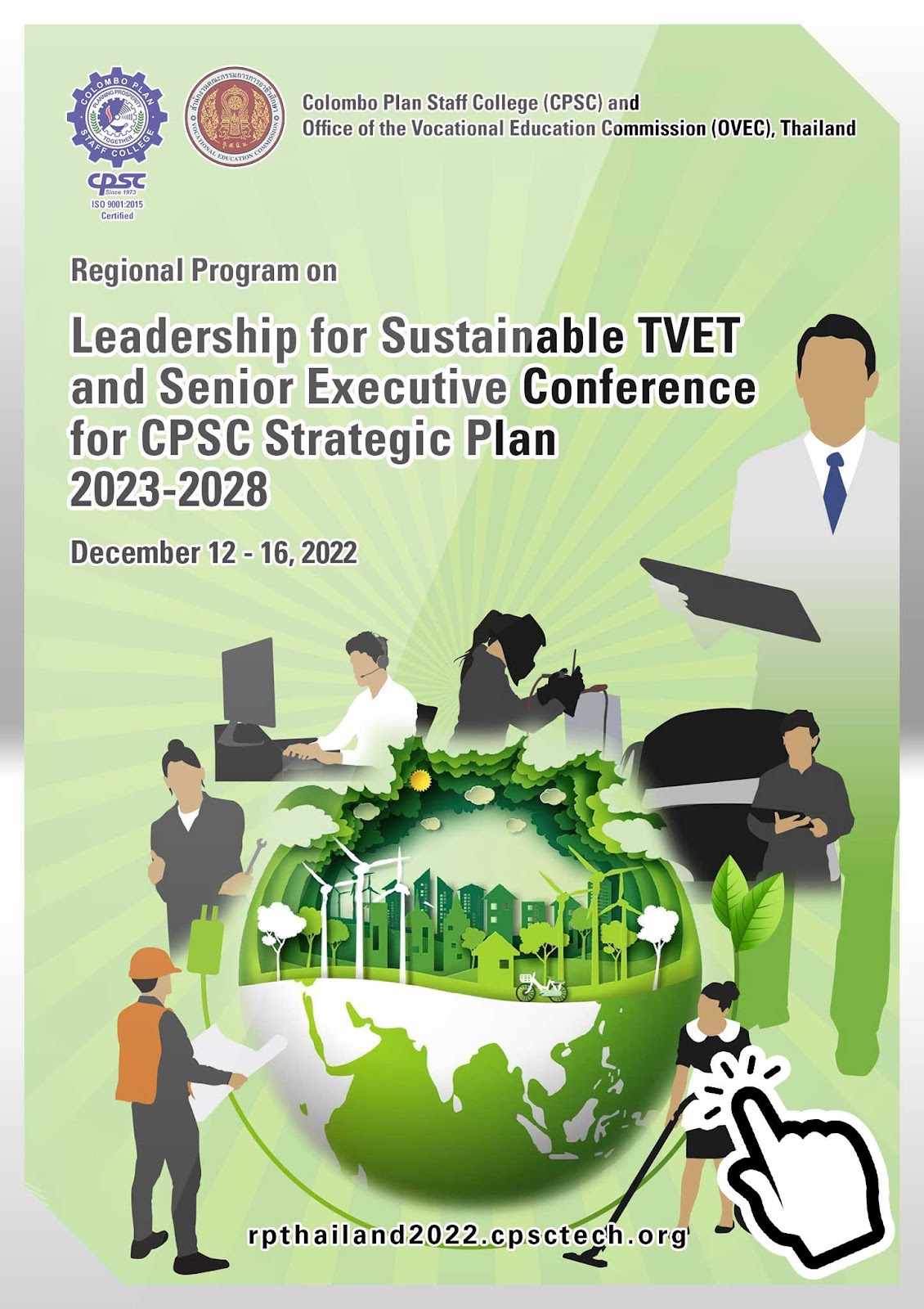
Date: December 12-16, 2022 /
Program Type: Regional Program /
Main Contemts
Objectives
The participants are expected to:
Comprehend the role and significance of a strategic plan in the development of national public interest.
Understand the role and significance of the CPSC strategic plan’s elements such as vision, mission, strategic goals, and objectives, and be able to identify formulations of those elements that are in line with National requirements.
Provide check-and-balance controls for the vision, mission, strategic goals, and objectives drafted by the NCW and expert participants and ensure that the outputs that they review are linked with their national agenda.
Provide validation to the Strategic Plan inputs and made by the delegates of the National Consultation Workshop (NCW) and Experts Meeting (EM).
Ratify and recommend the Strategic Plan 2023-2028 to the CPSC Governing Board for implementation.
Program/Conference Strategies
To achieve the objectives set forth, the following strategies will be employed in a consultative nature:
Presentations on the following:
CPSC Performance Overview & Strategic Focus
CPSC’s Strategic Plan 2018-2023, Highlights and Status Report, and Issues and Challenges for the Future (Softcopy)
Sustainable TVET Strategies on a Global Perspective.
Country Paper Presentations on TVET Challenges:
Skill Migration & TVET Branding (Philippines )
TVET Accreditation and Quality Assurance (Malaysia)
Digital and Virtual TVET (India)
TVET image Building: Singapore’s Success Story
Strategies on Transformation to workplace learning for Future-Ready TVET
CPSC Strategic plan 2023-2028 Process + Results of the expert Meeting 2022 in Malaysia
Exercises and workshops on the following:
Potential Programs and Expectations for CPSC in View of the Member Countries input requirements
Analysis and Synthesis of the National Consultation Workshop, Expert meeting Results and the Crafting of the Activities
International Seminar on “Leadership & Strategy for Sustainable TVET”
The international seminar on “Leadership and Strategy for Sustainable TVET” aims to bring together additional participants in order to share and discuss emerging challenges and best practices as shared by selected TVET experts. For this program, experts from Singapore are invited to share their country’s experience and best practices particularly on “Image Building” and “Strategies on Transformation to Workplace Learning for Future-Ready TVET”, with the aim of replicating and learning from the Singaporean model in implementing strategies for Sustainable TVET.
The seminar will also convene a panel of experts that will further digest and discuss the inputs of the speakers vs the feedback from various invited stakeholders in the event. The panel will also be helpful in contextualizing these inputs into tangible plans of action that will benefit the stakeholders in adapting a careful strategy through the analysis of best practices from other systems.
Date: November 28-December 2, 2022 /
Program Type: Customized Program /
Main Contemts
The delivery of the program design follows a spiral learning approach, begins with an overview of core concepts to be followed by progressively deeper application of the concepts and finally, a self-directed learning approach through action planning.
The main contents of the program are:
Special Lecture
Popularizing TVET: Concepts, Strategies and Mechanisms
Presentations
Presentation 1: TVET Institutes Management for the Global Competitiveness
Presentation 2: CBT Curriculum Approach in TVET
Presentation 3: CBT and Assessment System in TVET
Presentation 4: Developing a Curriculum Structure Integrating 21st Century Skills and IR 4.0
Presentation 5: Enhancing Employability of Youth for Global Citizenship
Presentation 6: Application of ICT and Digital Skills in Institutional Management and Teaching
Presentation 7: Developing ICT Tool or Mobile App for Teaching and Learning
Presentation 8: National Skills Information System, its Application & Benefits
Presentation 9: Digitization in MIS and M&E
Presentation 10: Excellence of Leadership for Change Management Through PDCA Cycle in TVET Institution
Expected Outcome
Manage TVET institutions effectively and efficiently with 21st century management competencies
Objectives
Generally at the end of the program, the participants are expected to enhance their supervisory competencies and be able to:
Supervise implementation of quality standards and procedures
Facilitate the promotion of programs and services
Specifically at the end of the program, the participants will be able to:
Equip knowledge and skills to adapt appropriate strategies in managing TVET and formulate actionable plans to enhance TVET systems and processes in their institution
Promote technical cooperation among TVET institutions on the different programs related to Industry Revolutions 4.0
Identify the challenges encountered in each TVET institution in terms of management and leadership as they adapt the IR 4.0
Date: November 14-18, 2022 /
Program Type: Regional Program /
Main Contents
Online real-time lectures
Workshops with Busan's Experts
Country-based Analysis $ Discussion
Objectives
To build the capacity required for operating and managing Intelligent Transportation System (ITS) in CPSC member countries with the experience and practices of South Korea and Busan
To facilitate interaction and discussion about how to utilize ITS in CPSC member countries for pursuing socio-economic progress
Date: November 6-12, 2022 /
Program Type: Regional Program /
Main Contents
Objectives
The participants are expected to:
Comprehend the role and significance of a strategic plan in the development of a TVET institution.
Understand the role and significance of the strategic plan’s elements such as vision, mission, strategic goals, and objectives, and be able to formulate a draft of those elements.
Provide check-and-balance controls for the vision, mission, strategic goals, and objectives drafted by the NCW participants and ensure that the outputs that they will draft are linked with the previous findings.
Meeting/Workshop Strategies
To achieve the objectives set forth, the following strategies will be employed in a consultative nature:
Presentations on the following:
Introduction on the CPSC Strategic Planning Process
CPSC’s Strategic Plan 2018-2023, Highlights and Status Report, and Issues and Challenges for the Future
Summary of the Strategic Planning Survey Results: Performance, Program Needs Analysis, and TVET Trends
Outcomes of CPSC’s National Consultation Workshop (Vision, Mission, Goals)
Fundamentals of Strategic Planning in the Context of TVET
Best Practices in TVET Strategic Management: the Malaysian Experience
Country Paper Presentations on TVET Challenges and Approaches: Emerging Training Needs and Initiatives
Emerging Program Thrust Areas for the Next Five Years
TVET Strategies on Global Perspective
TVET and Digital Skills in the 21st Century
Exercises and workshops on the following:
Potential Programs and Expectations for CPSC in View of the Country Presentations
Analysis and Synthesis of the National Consultation Workshop Results and the Crafting of the Activities
Date: November 3-4, 2022 /
Program Type: Customized Program /
Main Contents
Meeting/Workshop Strategies
To achieve the objectives set forth, the following strategies will be employed in a consultative approach:
Theme paper presentations on the following:
Understanding the Research Problem
Overview of the Research Process in TVET
Creation of a Research Proposal
xercises and workshops on the following:
Workshop on the appreciation of the Research Process in TVET
Workshop on the appreciation of the Research Process in TVET
Inputs
Lesson Plans and Program Modules
Draft Research Proposal
Situation paper of the research status in their respective TVET institutes
Handouts and theme paper presentations
Understanding the Research Problem
Overview of the Research Process in TVET
Creation of a Research Proposal
Expected Outputs
The meeting cum workshop activities are directed towards the formulation of a research proposal per program, which will be ready enough for implementation as a full-blown research.